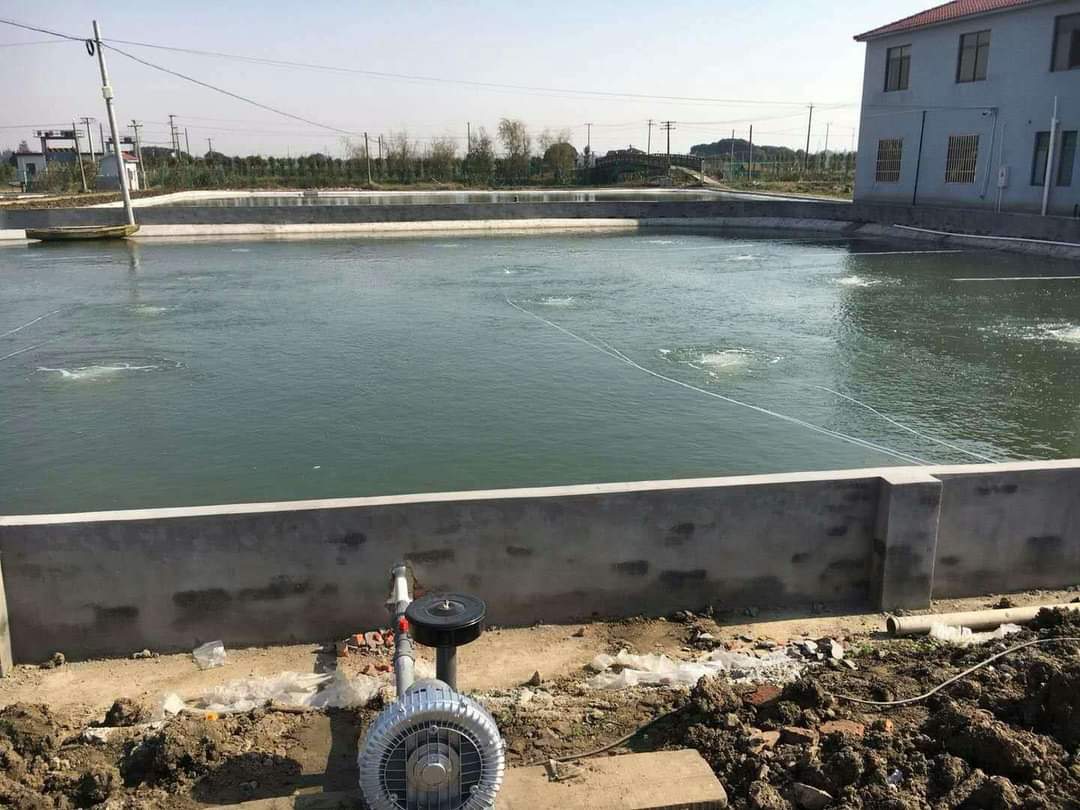
Microporous aeration pumps air through microporous tubing laid on the pond bottom, giving uniform dissolved oxygen over a wide aeration area. At the same motor power, a microporous aerator delivers about 3 times the oxygen of an impeller aerator.
How it works
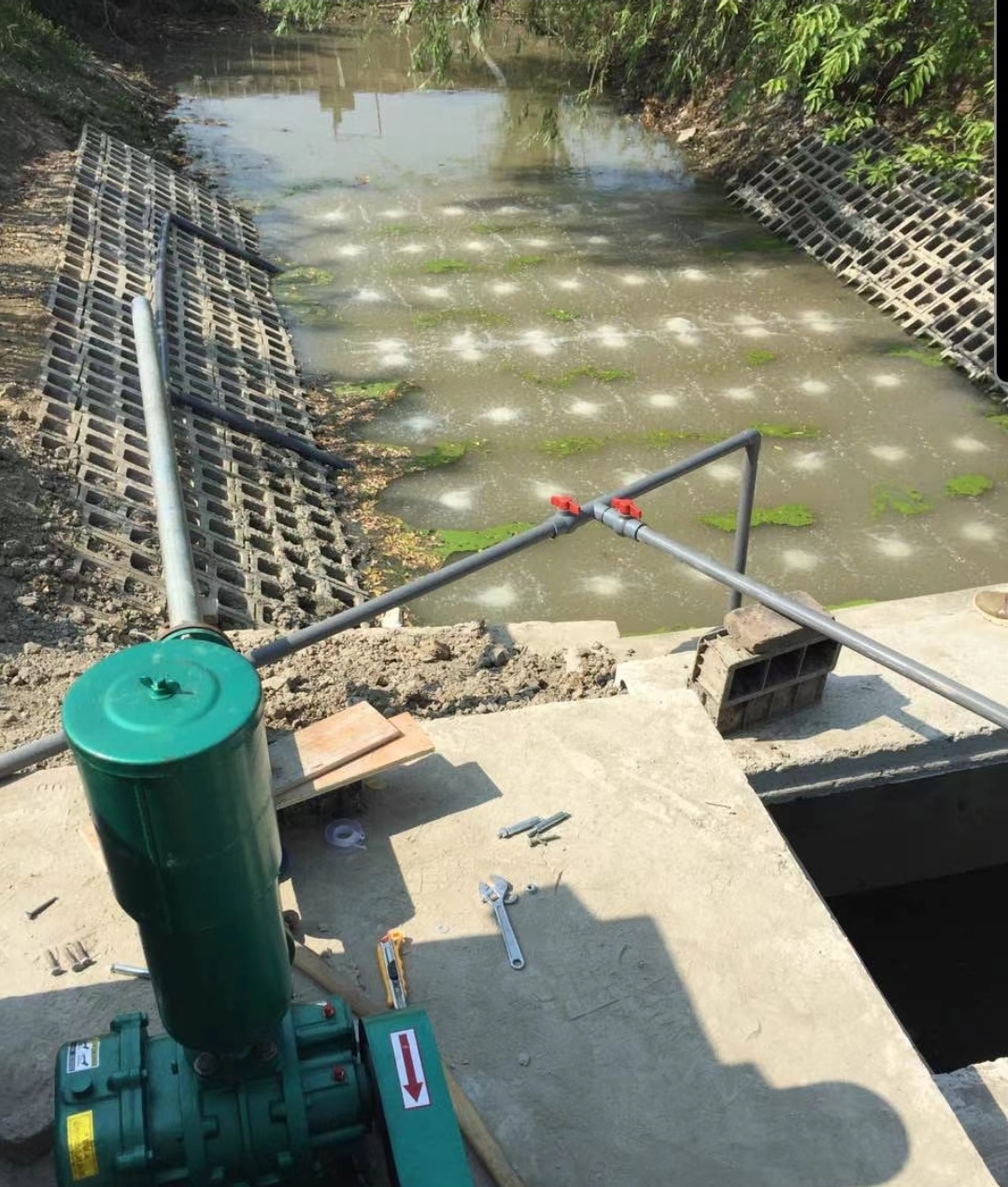
A roots blower feeds air into a delivery pipe, which carries it to microporous tubes; the tubes release the air into the water as micro-bubbles. The bubbles rise from the bottom, and under the high oxygen partial pressure the oxygen dissolves fully into the water. The rising flow also creates rotation and vertical movement: the vertical movement carries oxygen-rich surface water to the bottom, while the rotational movement spreads the oxygen-rich water around each tube, oxygenating the whole pond evenly.
Advantages
1. Power saving. The new blowers have a wide pressure range, simple structure, easy maintenance, long life and low vibration. Sub-surface aeration demonstrably works better than traditional methods: for the same result it saves 60-80% power. One 2.2 kW unit effectively aerates 30-40 mu (2-2.7 ha) of water surface.
2. Improves the ecological environment. The bubble streams from the bottom spread widely: at 2 m depth the misted bubbles diffuse over 3-4 m; one 1.2 m sub-surface aeration disc creates a vortex bubble flow covering 35 m2. Plenty of air contacting a large water surface keeps bottom dissolved oxygen at 6.5 mg/L, speeds up oxidation of organic sludge and harmful substances such as nitrite, and carries harmful gases out of the water - stabilising water quality and reducing disease for fish, shrimp and crab.
3. Supports high-density farming. Bottom aeration oxygenates the static bottom layer; with sufficient dissolved oxygen in the whole water column, the stock is more active, feeds better and grows faster. For vannamei shrimp with sub-surface aeration, stocking density can reach 80,000-100,000 fry per mu with yields around 1,000 kg; for Chinese carps, stocking can double. Better water quality means less stress and disease, higher survival, better appetite and faster growth.
4. Easy to use. Different pond sizes simply use different blower powers; one blower can aerate two or more ponds, and mains, branches and tubing are easy to connect and replace.
5. No electricity in the water. Unlike conventional aerators, microporous aeration puts only pipes in the water and the motor on shore - there is no possibility of a water-side electric leak.
6. Nothing can wrap around the motor. Waterborne debris cannot snag or damage the motor or reduce aeration.
Structure and installation
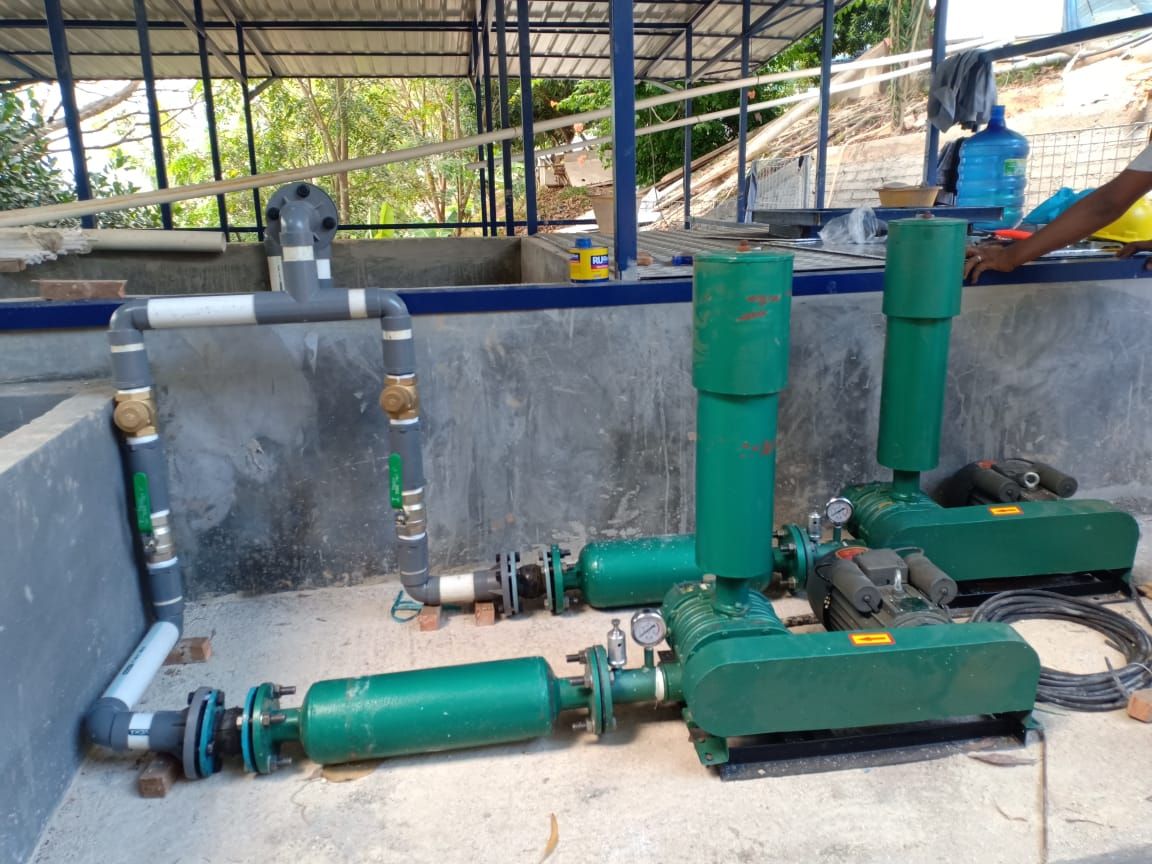
The system consists of the motor unit, a roots blower (1,400 rpm), an air-buffer tank, mains (PVC), branch pipes (PVC or rubber hose) and the microporous nano tubing. The motor drives the blower by belt; the blower feeds the buffer tank; the tank feeds the main; the main feeds branches; branches feed the tubing. Two common layouts:
1. Disc layout. Allocate 0.1-0.15 kW of blower per mu. A disc frame is made from 4-6 mm rebar with tubing fixed to it, 15-20 m total per disc, 3-4 discs per mu (or 2-3 discs with 30 m of tubing per disc), fixed 10-15 cm above the pond bottom.
2. Strip layout. Allocate 0.1 kW per mu, about 60 m of tubing in total, tube spacing around 10 m, height difference under 10 cm, fixed 10-15 cm above the pond bottom.
Operating schedule
Follow the dissolved-oxygen curve to decide when to run: in April-May run at midnight on overcast/rainy nights; in June-October run 2-3 hours in the afternoon and 2-3 hours starting one hour before dawn; in prolonged overcast or low-pressure weather run from 21:00-22:00 until noon the next day; in late culture run more often to boost growth. If you have a DO meter, run to keep dissolved oxygen at 6-8 mg/L.
Maintenance
1. Replace broken microporous tube promptly.
2. If algae clog the pores, dry the tube in the sun for a day and tap it to shake the material off, or soak it in 20% laundry detergent for 1 hour, rinse and dry.
3. Keep the power box leak-free.
4. Lubricate the roots blower on schedule.
5. Protect against rust during the rainy season.
6. Shade the equipment from summer sun (a canopy works).
7. Fix any loose connections at once.
8. At the end of the production cycle, disassemble and store indoors.
Jiangyin Zhongxin Machinery — one-stop aeration solutions. Contact: +86 180 1341 8091 / +86 180 1341 8097 (WhatsApp / WeChat).