Floating Pond Aerators for Fish Ponds & Fishery: 4-12 Mu
Floating aerator and fish pond aerator machines with variable-frequency drive — oxygenate 4–12 mu per unit with an efficient motor core.
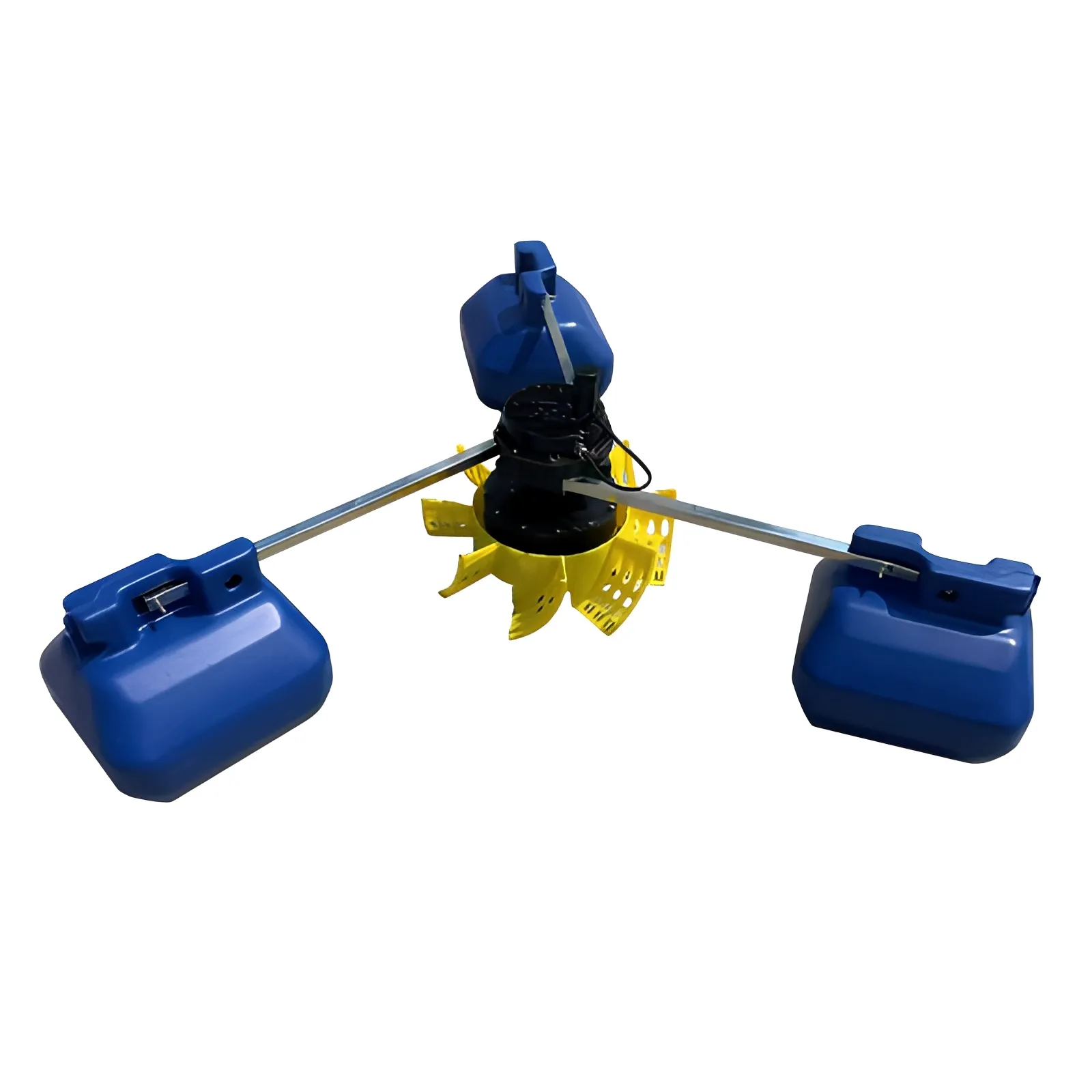
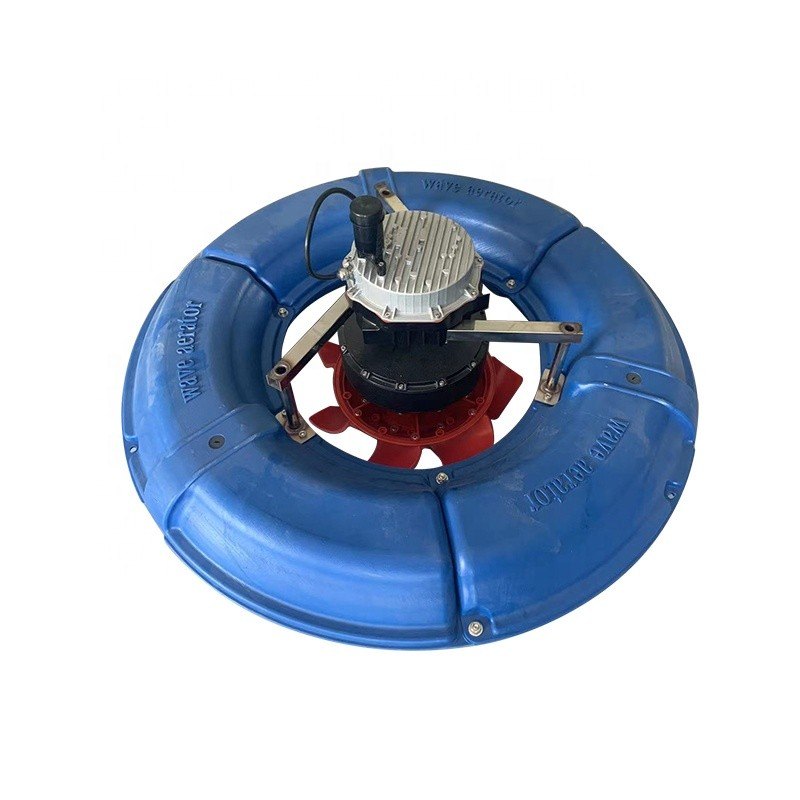
How a floating pond aerator works
A fish pond aerator combines water lifting, stirring and oxygenation in one machine that sits on the pond surface. The impeller throws water into the air, where it breaks into droplets and absorbs oxygen, while the surrounding flow circulates the pond water and keeps the whole column moving. Because the machine floats, it works at any water depth and follows the water level automatically — the practical choice for ponds that cannot take a fixed blower house, and a common backup to bottom aeration.
A single unit typically covers 4–12 mu of pond, depending on model, stocking density and water depth. For deep ponds, pair a floating aerator with bottom microporous aeration: the surface unit mixes and cools, the bottom tubing oxygenates the sediment layer — a combination many farms adopt for maximum dissolved oxygen control.
Floating fishery aerators: where they fit
A floating fishery aerator is the same machine as a pond aerator, used where the water is worked as a fishery rather than as one farm pond: hatchery and nursery tanks, cage and pen sites that need a movable unit, and reservoirs where there is no blower house to pipe air from. Because the machine floats, it follows the water level and can be towed between sites.
For a fishery that runs several water bodies in rotation, one floating fishery aerator can be moved to whichever pond is stocked or under oxygen stress that week, instead of building a fixed aeration system for each one. The impeller and the floating hull are the same across the range, so the sizing advice below applies to both pond and fishery use.
Model range & performance (official data)
| Model | Type | Power (kW) | Voltage | Oxygenation (kg/h) | Pond load (mu) |
|---|---|---|---|---|---|
| BYL-1.5-1-S | Impeller | 1.5 | 380 V 3-phase | 3.5 | 4–8 |
| BYL-1.5-2-S | Impeller | 1.5 | 220 V 1-phase | 3.0 | 4–6 |
| BYL-2.2-S | Impeller | 2.2 | 380 V 3-phase | 4.0 | 6–10 |
| TSBYL-2.2-3.0 | Impeller | 2.2–3.0 | 380 V 3-phase | 4.5 | 8–12 |
| BBQ-2.0 | Aeration type | 2.2 | 380 V 3-phase | 4.2 | 6–10 |
VFD permanent-magnet technology saves energy
Our floating aerators use a permanent-magnet motor with a variable-frequency drive (VFD). Unlike fixed-speed paddle wheels that run flat-out or not at all, a VFD aerator adjusts speed to the oxygen demand of the pond: run at full speed in hot weather or after feeding, and drop to low speed at night or in cool seasons. Field practice shows the inverter control alone saves 20–30% of the electricity of a fixed-speed aerator, on top of the roughly 50% saving that fine-bubble systems already bring.
The permanent-magnet motor is smaller and lighter than an induction motor of the same power, runs cooler and quieter, and starts softly — no current surge that trips farm breakers. Choose 220 V single-phase for small ponds or 380 V three-phase for larger installations, and always connect the residual current device (RCD) recommended in the user manual.
Choosing the right model for your pond or fishery
Match the aerator to the pond surface area, depth and stocking density: as a guide, about 4–8 mu for the standard models, up to 8–12 mu for the largest VFD units. Round ponds with central circulation benefit from one aerator placed at the edge; long rectangular ponds need two units at opposite ends. In emergency oxygenation — power cuts, sudden oxygen drops after storms — a floating aerator restores surface dissolved oxygen in minutes, which is why many farms keep one even when their main system is bottom aeration. Where several ponds are stocked at different times, a single floating fishery aerator can be moved to whichever one is under oxygen stress that week.
Every unit comes with an installation and user manual covering wiring, safety and troubleshooting, plus the same 3-month replacement / 1-year repair warranty as our blowers.
Installation and seasonal care
Anchor the aerator so it cannot drift into the banks or entangle feed lines; leave enough slack in the power cable for normal movement and protect the plug against rain. In winter, when ponds are idle, lift the machine out of the water, drain it and store it in a dry shed to protect the motor and impeller.
For aeration layout advice — floating, bottom or a combination — send us your pond size, depth and species, and our engineers will propose the complete system with the correct model and power.
Floating aerators vs paddle wheels
A traditional paddle wheel throws water with fixed blades at fixed speed; it mixes the surface layer well but uses full power even at night when demand is low. A VFD floating aerator adjusts speed continuously: full speed at midday or after feeding when oxygen demand peaks, reduced speed at night, and minimal speed in cool weather. Across a season this speed control typically saves 20–30% of the electricity of a fixed-speed unit, and the permanent-magnet motor is quieter and lighter.
Both machines have their place. Farms often keep one paddle-type aerator per few mu purely as an emergency surface-oxygenation backup, while the VFD aerator handles routine duty. Tell us your power budget and we will recommend the mix.
Warranty, spares and support
Every floating aerator is test-run in our workshop before packing, and the user manual covers installation, 220 V and 380 V wiring, residual current device (RCD) requirements, daily checks, troubleshooting and seasonal storage. The warranty is 3-month replacement and 1-year free repair, with spares — impellers, shaft seals, motor controllers — stocked for fast dispatch.
For ponds larger than 12 mu (about 0.8 ha) or unusual shapes, we design multi-unit layouts and can supply the aerators together with blowers, microporous tubing and accessories in one shipment, so every part of your aeration system comes from one source with one service contact.
Documents you can download
Each VFD aerator ships with a user manual covering installation, wiring diagrams for 220 V and 380 V supply, RCD safety requirements, maintenance intervals and troubleshooting tables. The manual is also available as a PDF download on the product page, together with the factory inspection records for the drive and motor. Our engineers can review your pond plan and confirm power and unit counts before you order. For multi-unit farms we provide a wiring schematic and a starter checklist so your electrician can install everything in one visit, with the correct breakers, cable sizes and RCD ratings already marked.
Rated by aquaculture farms worldwide
The ZXMSR blower has run two full seasons without a single stop, and the factory layout support was excellent.
We switched eight ponds to microporous tubing — electricity dropped by about a third and the crop grew through the hot season.
Buying direct from the factory
Jiangyin Zhongxin Machinery Equipment Co., Ltd. is an industrial aeration system manufacturer based in Jiangyin, Jiangsu, China. We build the roots blowers, the microporous tubing and diffusers, and the floating pond aerators ourselves in our own workshops — so a pond aeration system is matched as one design, not assembled from three different suppliers.
The notes below apply to our floating aerators as well as to the rest of the range.
- OEM & ODM: Custom voltage (220 / 380 / 460 V, 50 or 60 Hz), freshwater or seawater-rated materials, your brand on the nameplate and packaging.
- MOQ & samples: MOQ depends on the model and how far the customization goes — quoted per order; sample units are available for evaluation on standard configurations.
- Lead time: Quoted per configuration and quantity, and counted from the point the specification is frozen.
- Trade terms: FOB (Shanghai / Ningbo) and CIF supported; export documentation handled in-house.
- Engineering support: Send pond area, depth and stocking density — we size the pond aerators or the blower-and-tubing system for you. Off-grid ponds run the same equipment on solar and battery supply: a solar pond aerator setup is sized at roughly 1 kW of panel per kW of blower, as set out in our off-grid solar aeration guide.
See the factory and the full product line · Ask for a sizing sheet and quotation
Buying direct: common questions
Can you customize the voltage for my country?
Yes. Motors are wound for 220 / 380 / 460 V at 50 or 60 Hz and the control panel is configured for the same grid. Tell us the voltage, phase and frequency at the quotation stage — a mismatched or rewound motor runs hot and loses performance, so this is decided before production, not at shipping.
Do you offer OEM / private-label production?
Yes, both OEM (built to your drawing or specification) and ODM (our existing designs adapted to your market). Nameplates, model coding, cartons, manuals and float colours can carry your brand, and the branding details are fixed at the sampling stage so the first batch matches what you sell.
What is your MOQ and lead time?
Both depend on the model and the level of customization, so they are quoted per order and confirmed in writing rather than published as fixed figures. Standard configurations can usually be sampled; customized SKUs need a minimum batch because of tooling and material minimums. Lead time runs from the moment the specification is frozen.
How do I verify a factory before placing an order?
Ask for the plant address (city and province, not just "China"), a video of the production process for the product you are buying, the list of parts made in-house versus bought in, a pressure/airflow record at your duty point, and references at your scale. We are the manufacturer rather than a trading company, so these answers come with data — and a video call through the workshop can be arranged during your due diligence.
What is a floating pond aerator used for?
Moving oxygen into the layer a surface machine can actually reach: shrimp and fish ponds of roughly 4–12 mu (0.66–2 acres) per unit, emergency aeration when dissolved oxygen falls overnight, and sites with no mains supply where a diesel or solar source runs one machine. It is the usual choice where a farm wants a single movable unit instead of a fixed blower-and-tubing system.
What is a floating fishery aerator?
The same machine under the name used where the water is worked as a fishery rather than as one farm pond: hatchery and nursery tanks, cage and pen sites that need a movable unit, and reservoirs with no blower house. Because it floats it follows the water level, and it can be towed to whichever pond is under oxygen stress that week.
Is a fishery aerator different from a pond aerator?
No - the machine is the same. What changes is the water it is used on and how it is sized: a fishery usually runs several water bodies of different depth and stocking, so the unit is chosen for the pond it will be moved to next, and for how quickly it can lift surface dissolved oxygen in an emergency.
Ask about Floating Aerators
Request specifications, prices and lead times — our engineers reply within 24 hours.