RAS & indoor farming
Recirculating systems concentrate fish waste and CO₂; oxygen demand is high and consistent, and downtime is expensive.
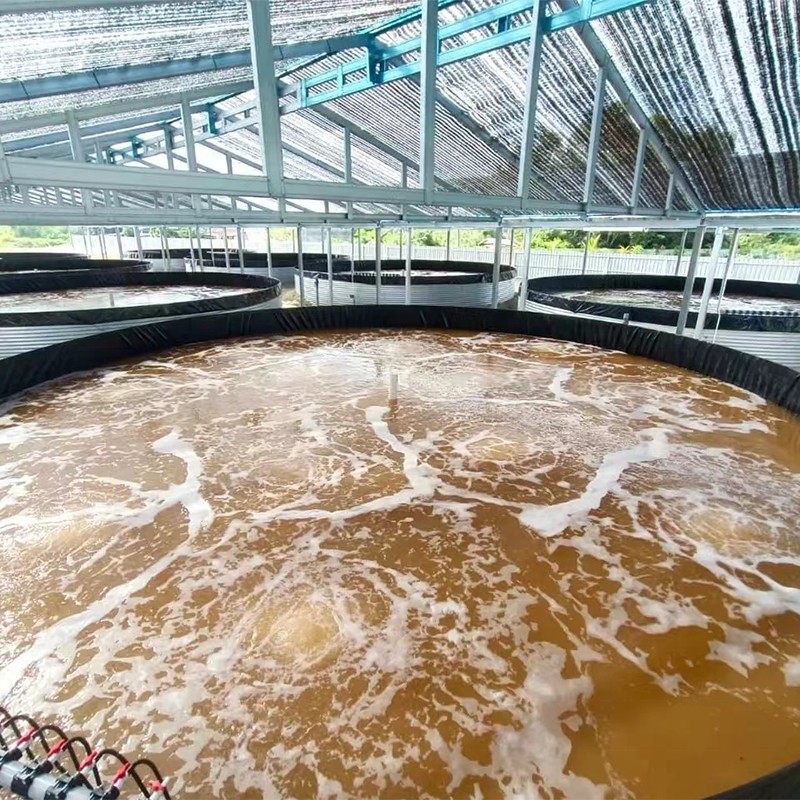
Our solution
Continuous fine-bubble aeration keeps dissolved oxygen stable across every tank, while airflow from the bottom lifts solids toward the drain for removal.
- Stable DO ≈ 4.5 mg/L with continuous operation
- Uniform aeration across circular and square tanks
- Low noise — no stress response in stocked fish
- Blowers can be placed on shore, outside the tank room
Recommended system
Intensive Roots blower + aeration disc arrays + galvanized canvas tanks
Oxygen is the throughput limit in RAS
In a recirculating system the stock is held at a density that would not be possible in a pond, so oxygen demand per cubic metre is several times higher and it never pauses. Mechanical filtration and biofiltration consume oxygen as well, which means the aeration duty covers the bacteria and not only the fish. Sizing to the average demand leaves the system short at the two moments that matter most: just after feeding, and during any interruption to a pump or blower.
Layout for tanks rather than ponds
Aeration discs suit circular and rectangular tanks because they can be distributed to give an even oxygen profile instead of a single plume. Placing the diffusers off-centre helps twice over: the rising bubble column drives a slow rotation that carries solids toward the centre drain, so the same air is doing part of the solids-removal work. Blowers can be sited outside the tank room, which keeps both noise and waste heat out of the production space.
Designing for downtime
A RAS has little buffering water volume, so a stopped blower becomes a mortality event in minutes rather than hours. Plan the air supply as two independent trains with a spare blower kept on the manifold, and wire the dissolved-oxygen alarm to the same circuit as the aeration relay so the two cannot disagree about whether air is flowing. Target 4.5 mg/L or better in the tank outflow, and check it after a feed rather than before one.
What the tanks are made of
Galvanized canvas tanks are often used for the fish-holding side of an indoor system because they can be delivered flat and assembled on site, which matters in buildings where a rigid tank will not fit through the door. The aeration design does not change with the tank material — what changes is the mounting: diffuser runs are supported from the tank floor or frame rather than embedded, so a tank can be re-lined or repositioned without rebuilding the air distribution.
Need a system for your setup?
Tell us about your ras & indoor farming — our engineers reply within 24 hours on business days.