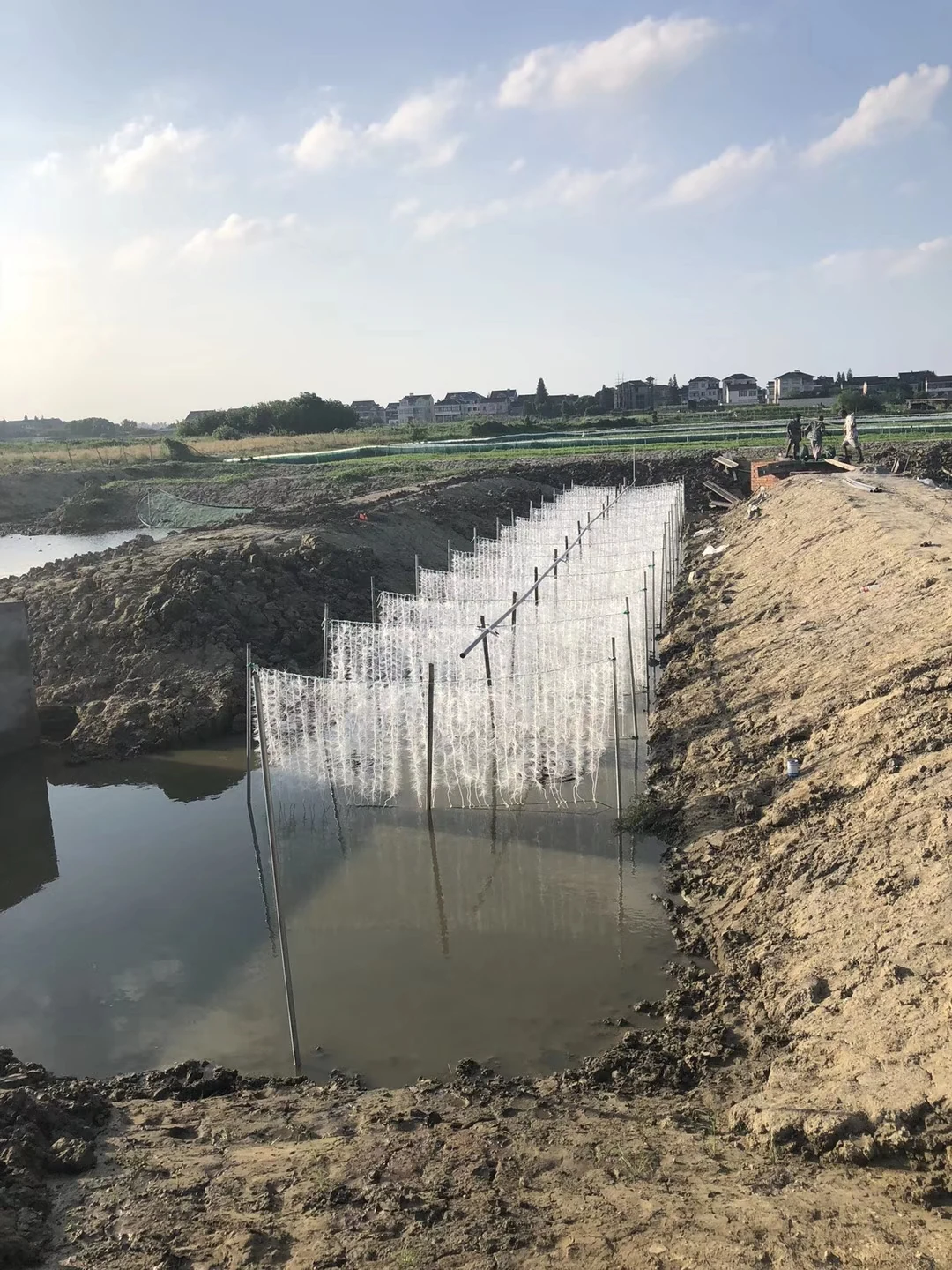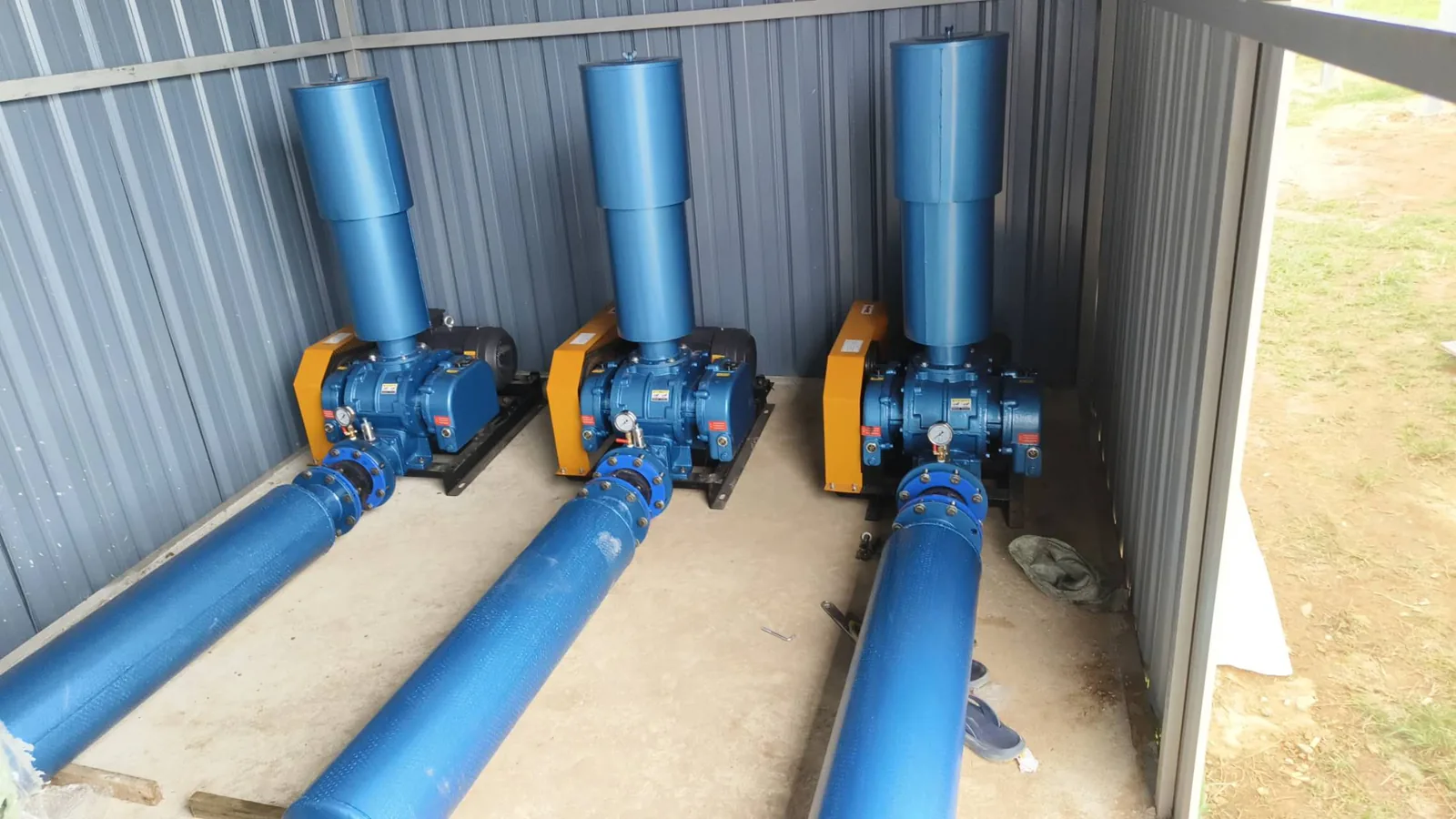
The Short Answer
Size your roots blower in two steps: air flow (FAD) = tubing length × 0.1–0.4 m³/h per metre, and pressure = water depth pressure + pipe friction + 15–20% headroom. A 3 m deep pond with 150 m of aeration tubing typically needs a blower around 3–5.5 kW with 0.4–0.5 bar of pressure. Choosing a blower that is too small is the most common and most costly mistake in aquaculture aeration.
---
Why Blower Sizing Matters
The blower is the heart of a bottom aeration system. Get it wrong in either direction and you pay twice:
- Too small: cannot overcome water pressure → little or no air at the pond bottom → low DO, poor growth, mortality risk. The system looks installed but does not work.
- Too large: wasted electricity every hour of every season, and unnecessary purchase cost.
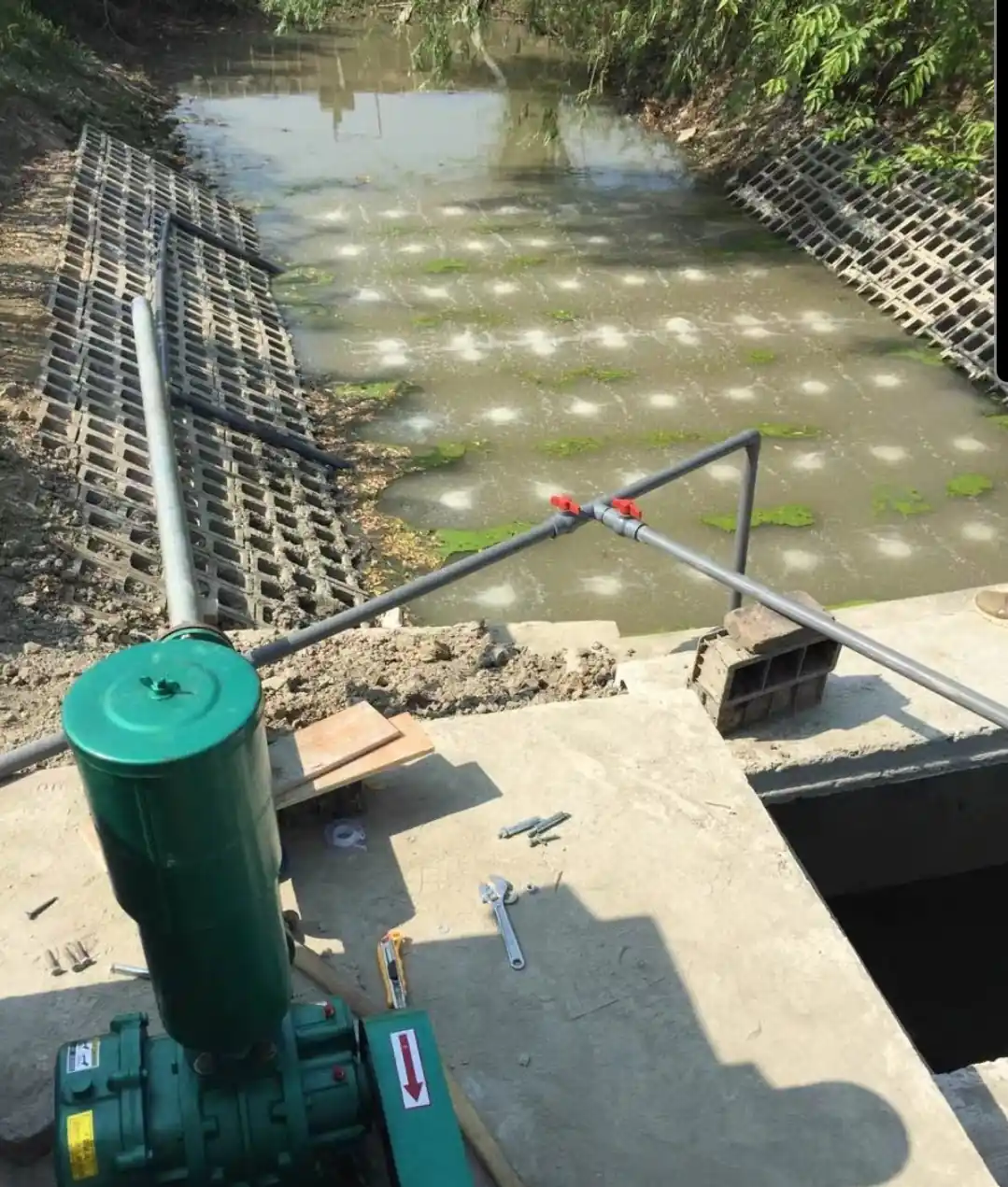
Unlike pumps, roots blowers are positive displacement machines: they hold pressure against a load. That makes them ideal for bottom aeration, where several lines of tubing run from one manifold—but it also means the blower must be sized for the total system, not just one line.
Three things to decide before you size
Pond area and stocking density. Air demand scales with the water you are treating, not only its surface. A high-density greenhouse pond needs more air than an extensive pond of the same size, so two ponds of equal area can land on different blower models.
Water depth. Depth sets the discharge pressure the blower has to hold, and therefore the motor power. A deep pond is a pressure problem more than an airflow problem.
Aeration layout. Decide whether you need local aeration — for example only around the feeding area — or whole-pond coverage. The two layouts call for different models and different tubing runs.
---
---
Step 1: Calculate the Required Air Flow (FAD)
Air flow (m³/h) = total tubing length (m) × working air flow per metre
Typical working air flow for microporous aeration tubing: 0.1–0.4 m³/h per metre (aeration rate 0.002–0.006 m³/min·m). Use the manufacturer's spec sheet value.
Example: 150 m of aeration tubing at 0.2 m³/h·m → 30 m³/h (0.5 m³/min) of free air delivery.
---
Step 2: Calculate the Required Pressure
Pressure (bar) = water depth pressure + pipe/accessory friction + headroom
| Water depth | Static pressure | Add friction + headroom | Recommended blower pressure |
|---|---|---|---|
| 1.5 m | 0.15 bar | +20% | ~0.18–0.25 bar |
| 2.0 m | 0.20 bar | +20% | ~0.25–0.30 bar |
| 2.5 m | 0.25 bar | +20% | ~0.30–0.35 bar |
| 3.0 m | 0.30 bar | +20% | ~0.35–0.45 bar |
| 5.0 m | 0.50 bar | +15% | ~0.55–0.65 bar |
Never undersize pressure. A blower that cannot reach the required pressure starves the far end of your tubing lines.
---
Step 3: Pick the Model from the Spec Table
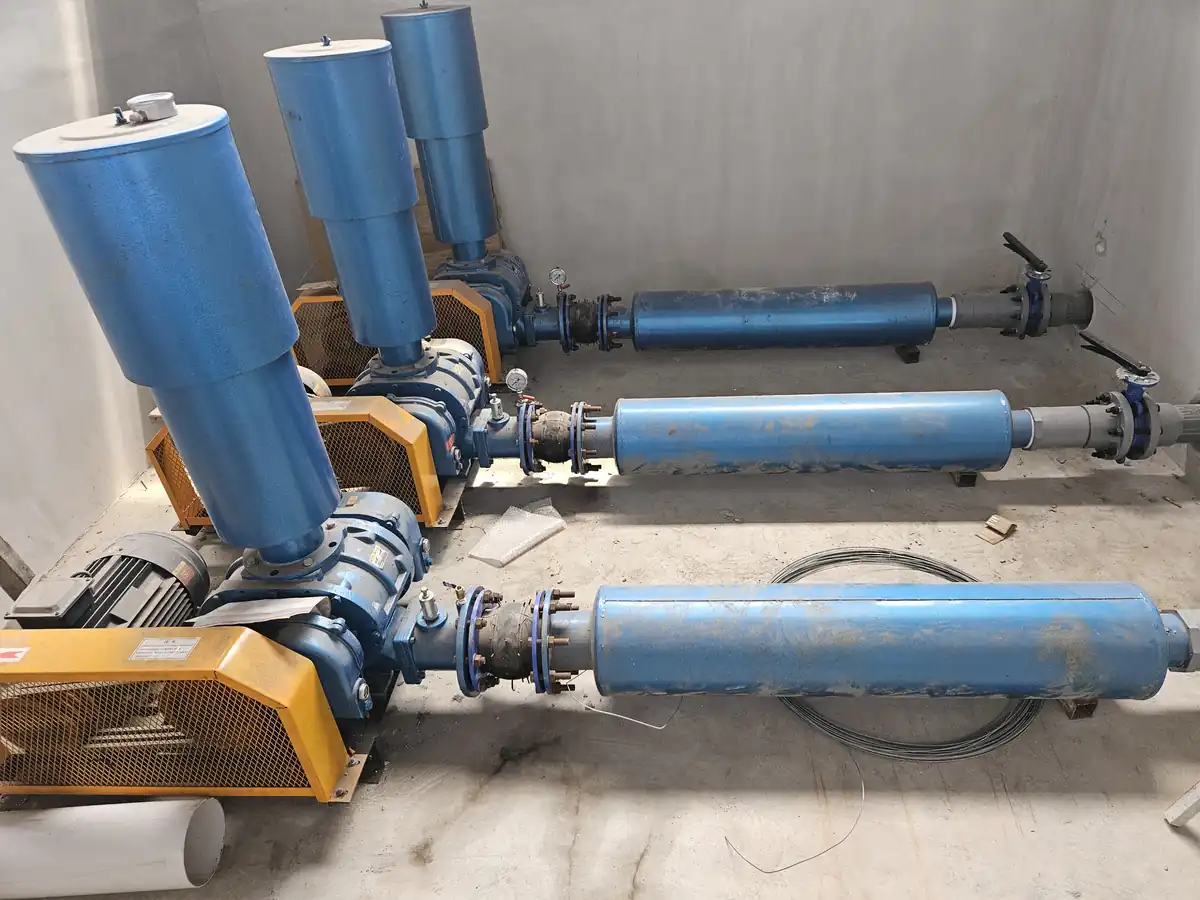
Reference ZXMSR series roots blowers (flow range 0.6–136.7 m³/min, pressure 9.8–58.8 kPa standard (higher-pressure models to 98 kPa available), motor 0.5–280 kW):
| Pond size | Tubing length | Recommended ZXMSR model | Motor power |
|---|---|---|---|
| 1–3 mu | 30–50 m | ZXMSR-65 | 0.75–1.5 kW |
| 3–5 mu | 50–80 m | ZXMSR-80 | 1.5–3 kW |
| 5–10 mu | 80–150 m | ZXMSR-100 / ZXMSR-125 | 3–5.5 kW |
| 10–20 mu | 150–300 m | ZXMSR-150 / ZXMSR-175 | 5.5–15 kW |
| 20–50 mu | 300–800 m | ZXMSR-200 / ZXMSR-250 | 15–55 kW |
Cross-check with the rule of thumb: 1 kW of motor power supports roughly 100–150 m of microporous tubing at typical pond depths.
---
Roots Blower vs. Regenerative Blower: Which One for Ponds?
| Criterion | Roots blower (positive displacement) | Regenerative blower |
|---|---|---|
| Pressure capability | High (up to ~1 bar) | Low-moderate (~0.2–0.3 bar) |
| Performance when lines partially blocked | Holds pressure, keeps delivering | Flow drops sharply |
| Multi-line systems | Excellent | Struggles |
| Deep ponds (> 2 m) | Recommended | Marginal |
| Maintenance | Oil change, belt check | Filter cleaning |
| Best for | Aquaculture bottom aeration, wastewater | Small tanks, shallow ponds |
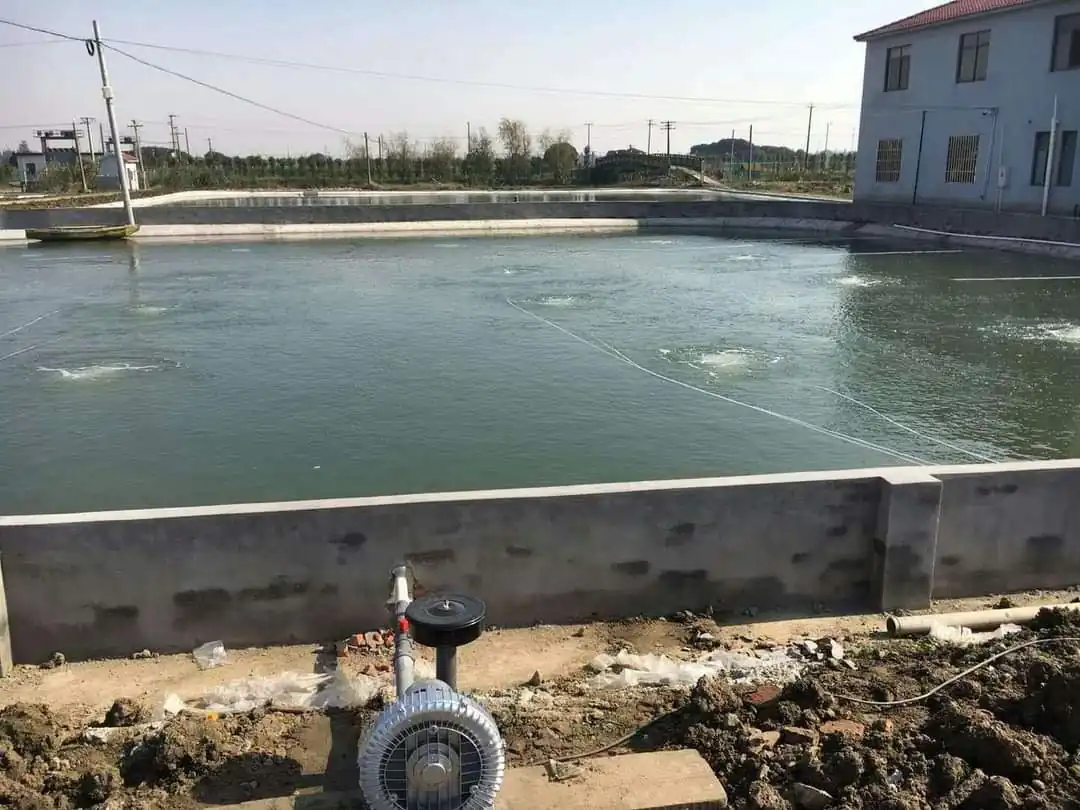
For aquaculture ponds deeper than 1.5–2 m, a roots blower is the correct choice.
---
5 Common Sizing Mistakes
1. Sizing by pond area alone — tubing length, not pond area, determines air demand. Two ponds of the same size can need very different blowers.
2. Ignoring depth pressure — adding 1 m of depth adds ~0.1 bar. Shallow-pond blowers fail on deeper ponds.
3. No headroom — old tubing, kinked hoses, and fouled filters all add resistance. Size with 15–20% margin.
4. One big blower with no backup — a summer-night outage can crash DO. A pair of smaller blowers (one duty, one standby) is often better than one large unit.
5. Buying the blower before the tubing — size the tubing first (service area 1–8 m²/m), then derive the blower.
---
Frequently Asked Questions
Q: How do I know the air flow rating of my tubing? A: Use the manufacturer's spec sheet values for working air flow (typically 0.1–0.4 m³/h per metre) and aeration rate (0.002–0.006 m³/min·m). If a supplier cannot provide these numbers, treat the product with caution.
Q: Can one blower feed several ponds? A: Yes, with a properly sized manifold and isolation valves per pond. The blower must cover the total air flow and the deepest pond's pressure.
Q: What pressure do I need for a 3 m deep pond? A: About 0.35–0.45 bar (water depth 0.3 bar + friction + headroom). Confirm against the blower's pressure–flow curve at your required flow.
Q: How much electricity will my blower use? A: A well-sized system runs at roughly 0.15 kW per mu. A 10-mu pond typically needs a 1.5–3 kW blower running ~20 h/day during the growing season.
Q: How often should I service a roots blower? A: Check oil level monthly, change oil per the manual schedule, and keep the intake filter clean. A maintained roots blower runs reliably for many seasons.
---
The Bottom Line
Size aeration blowers by air flow from tubing length and pressure from water depth, then match the model with 15–20% headroom. The ZXMSR series table above covers ponds from 1 to 50 mu; if your system is larger, the same two-step method applies with a bigger model.
Zhongxin Machinery manufactures both roots blowers and microporous tubing, so we can size the blower, manifold, and tubing as one engineered system rather than three guessed components. Send your pond area, depth, and tubing plan—we will reply with a blower recommendation and a pond-specific energy estimate.
Explore our Roots blower range →
---
References: FAO aquaculture guidelines on pond aeration; University of Florida IFAS extension notes on dissolved oxygen management; SRAC publications on aeration for aquaculture ponds; Global Seafood Alliance shrimp farming resources; scientific reviews on diffused aeration efficiency.
Not sure you want to work through the steps by hand? The aeration sizing calculator returns the same tubing length, air flow, pressure and blower power from four inputs.
Step 1 - Pond volume and target density
- Pond area in mu (1 mu = 667 m²) x average water depth (m) = volume (m³)
- Set your density class: low (<=0.15 kW/mu), medium (0.15-0.25), high (0.25-0.35). Shrimp at high stocking or biofloc go to the high end.
Step 2 - Tubing length
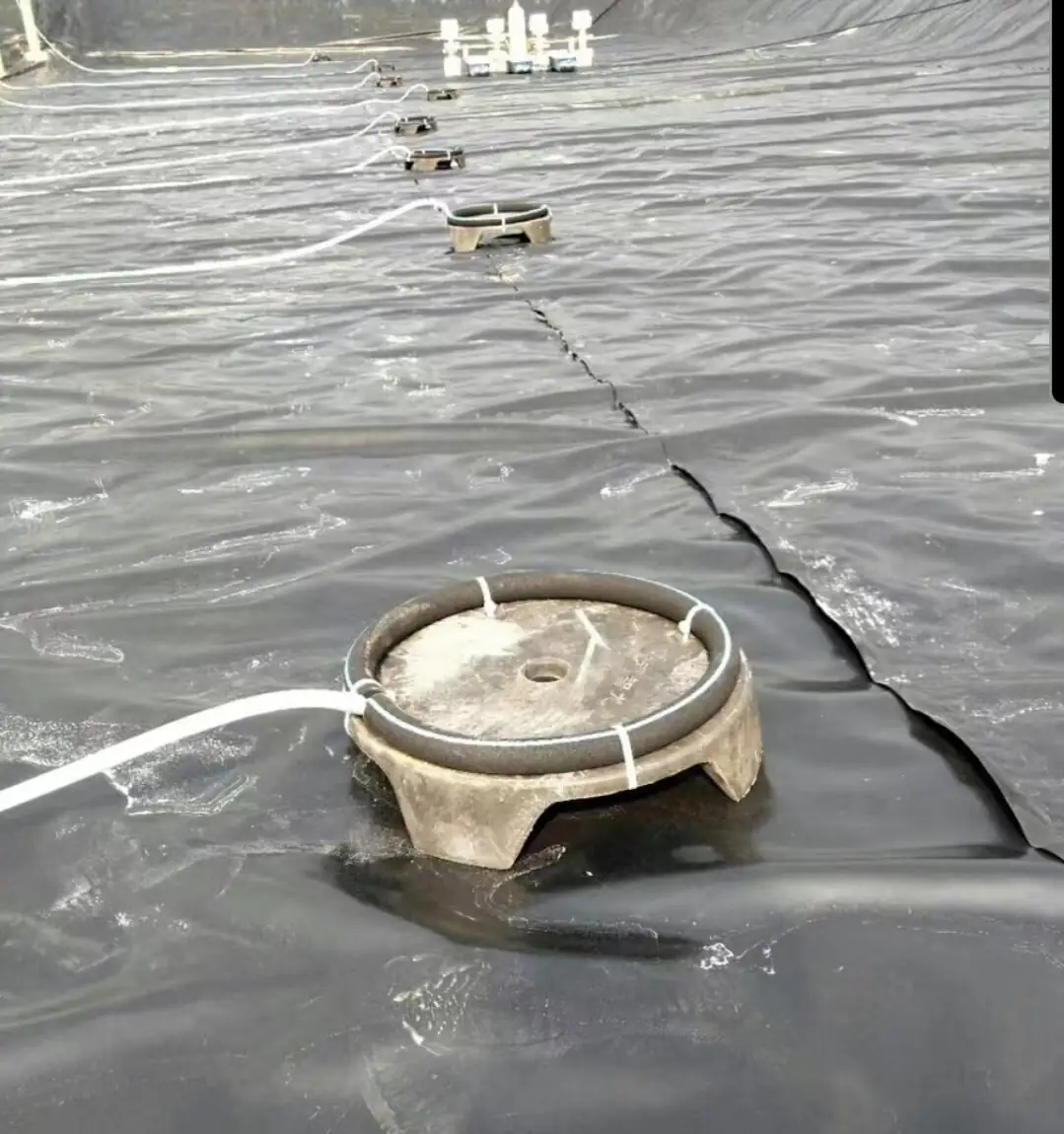
- Rule: 60-100 m of microporous tubing per mu, lines 3-5 m apart, laid 10-20 cm above the pond bottom.
- Example: 5 mu → 300-500 m. Use 400 m for the calculation below.
Step 3 - Air flow (m³/min)
- Microporous tube consumption: 0.002-0.006 m³/min per metre (fine pores, 1,000-1,600 holes/m).
- Flow = tube length x consumption per metre.
- Example: 400 m x 0.004 m³/min·m = 1.6 m³/min.
- Cross-check with the 1 kW per 100-150 m rule: 400 m → 2.7-4 kW (see Step 5).
Step 4 - Pressure (kPa)
- Static pressure ≈ water depth above the tubing: 1 m water ≈ 9.8 kPa. Tubing at 10-20 cm above the bottom in a 1.5 m pond → about 1.3-1.4 m of head ≈ 13-14 kPa.
- Add 15-20% for pipe, fitting and diffuser losses → ~16-17 kPa.
- Saltwater is ~2.5% denser - add a small margin for seawater ponds.
- Deep ponds (2.5 m+) and long mains need a blower with headroom: the ZXMSR series covers 9.8-58.8 kPa for standard models (higher-pressure models up to 98 kPa available), so depth is rarely the limiter - but never undersize pressure.
Step 5 - Power and model (kW)
- Power follows the tubing: 1 kW per 100-150 m of tube.
- Example: 400 m → 2.7-4 kW → select a 3-4 kW class blower.
- Cross-check against the area rule: 5 mu x 0.15-0.35 kW/mu = 0.75-1.75 kW (low-density ponds can run leaner). Take the larger of the two methods - the tubing-based figure is the conservative one.
- The ZXMSR three-lobe roots blower line spans 0.6-136.7 m³/min, 9.8-58.8 kPa for standard models (up to 98 kPa available), 0.5-280 kW - your point will land somewhere in that range; the manufacturer's selection table converts it to a model number.
Worked example A - 5-mu tilapia grow-out pond
- Area 5 mu, depth 1.5 m → volume ≈ 5,000 m³; medium density.
- Tubing: 400 m (80 m/mu).
- Flow: 400 m x 0.004 = 1.6 m³/min.
- Pressure: head ≈ 1.35 m → 13.2 kPa + 15% losses ≈ 15-17 kPa.
- Power: 400 m ÷ 125 m/kW ≈ 3.2 kW → 3-4 kW class.
- Check: 5 mu x 0.2 kW/mu = 1.0 kW < 3.2 kW → keep 3-4 kW (tubing method wins; the extra capacity buys headroom for hot-season DO dips).
Worked example B - 10-mu semi-intensive shrimp pond
- Area 10 mu, depth 1.8 m → volume ≈ 12,000 m³; medium density (semi-intensive).
- Tubing: 800 m (80 m/mu).
- Flow: 800 m x 0.004 = 3.2 m³/min.
- Pressure: head ≈ 1.65 m → 16.2 kPa + 15-20% losses ≈ 18.6-19.4 kPa.
- Power: 800 m ÷ 125 m/kW ≈ 6.4 kW → 7.5 kW class.
- Check: 10 mu x 0.20 kW/mu = 2.0 kW < 6.4 kW → keep 7.5 kW.