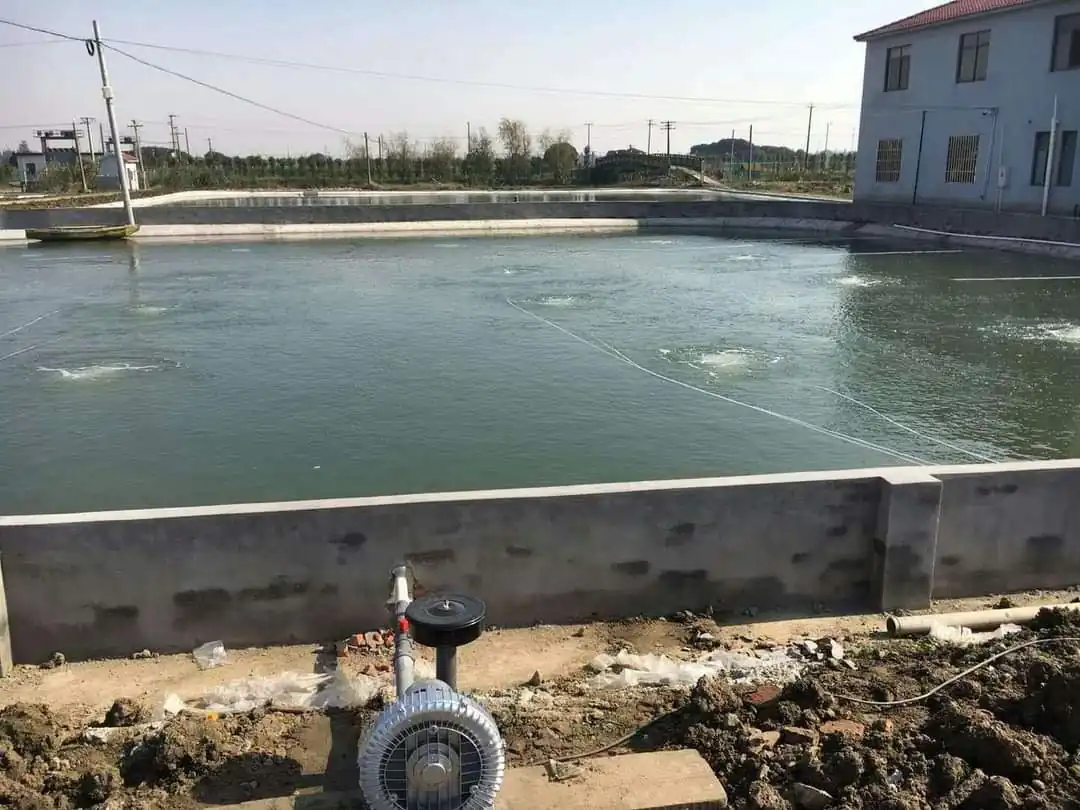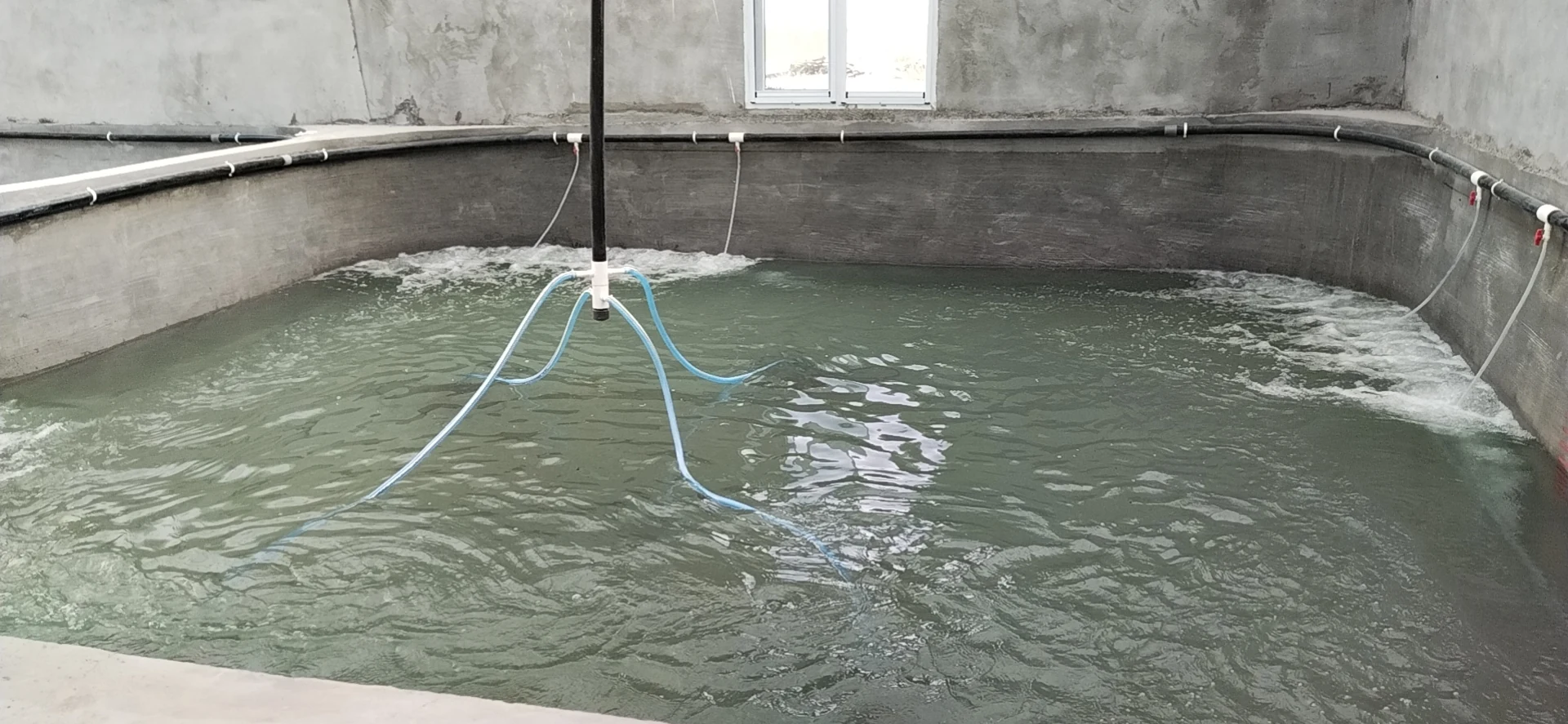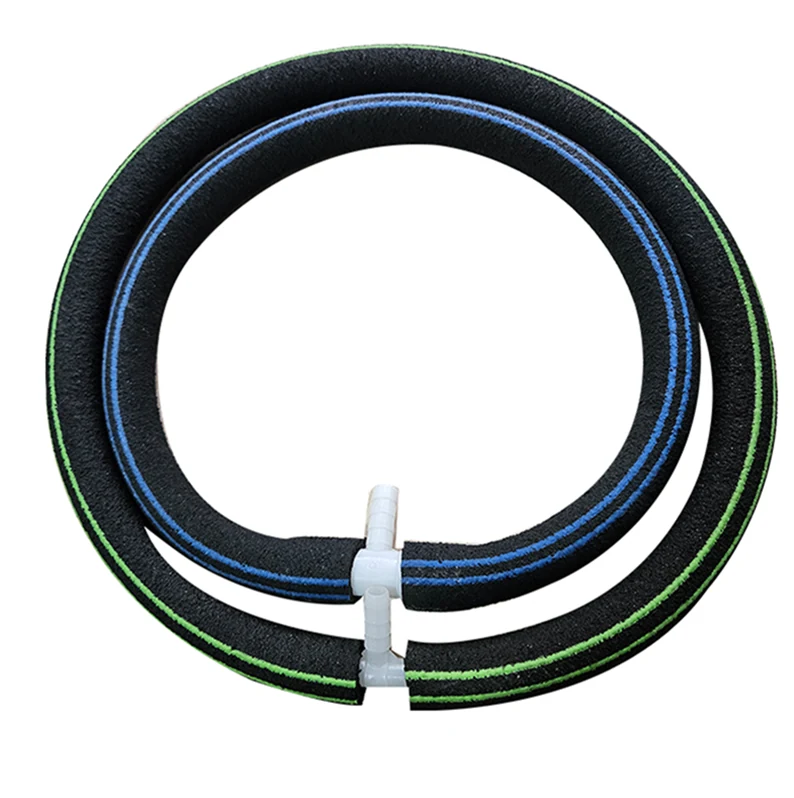
Microporous aeration technology uses microporous pipes to inject air at the pond bottom. The dissolved-oxygen distribution is even and the aeration area is wide. With the same main-engine power, a microporous aerator has 3 times the aeration capacity of an impeller (paddle-wheel) aerator.
How a microporous aeration system works
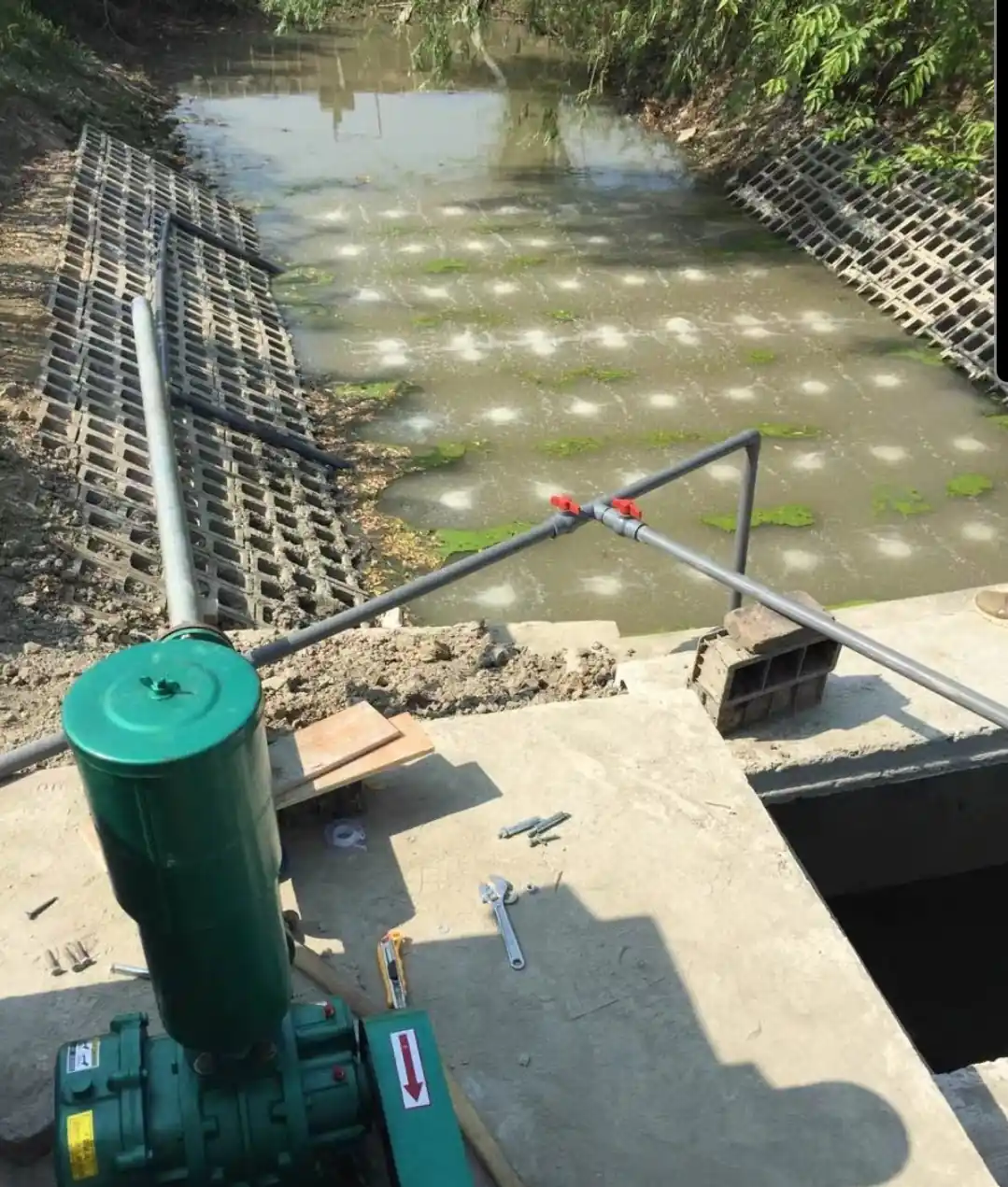
A roots blower sends air into the delivery pipe, the delivery pipe feeds the air into microporous tubes, and the tubes release the air into the water as micro-bubbles. The micro-bubbles rise from the pond bottom, and under the high partial pressure of oxygen in the bubbles, oxygen dissolves fully into the water. The rising bubbles also create rotating and vertical water currents: the vertical flow carries oxygen-rich surface water down to the bottom, while the rotating flow spreads oxygen-rich water away from around the tubes — achieving even aeration of the whole pond.
Why it saves electricity
The new blowers have a wide pressure range, simple structure, easy maintenance, long service life and low vibration. Practice has proved that underwater aeration works very well: compared with traditional aeration methods, it saves 60-80% of electricity for the same effect. One high-performance 2.2 kW aeration unit effectively aerates 30-40 mu of water surface.
A worked example shows how large that gap is. On a 10-mu (0.67 ha) pond at 1.5-2 m depth, reaching 10 kg O2/h of aeration capacity takes only about 1.5 kW with this system, where an impeller aerator needs 6-9 kW. Running 8 hours a day across 200 aeration days saves about 10,000 kWh and more than RMB 5,000 in running costs — which is what the 60-80% figure means in practice.
Water quality and the pond bottom
The bubble flow generated at the bottom covers a wide range: at a water depth of about 2 m, atomised bubbles spread 3-4 m. One underwater aeration disc 80 cm in diameter produces vortex-type bubble flow and effectively aerates 25 m². The sufficient airflow in contact with a large water area keeps the dissolved oxygen at the bottom at 6.5 mg/L, speeds up the oxidation and decomposition of organic matter and harmful substances such as nitrite deposited at the bottom, and carries toxic gases out of the water — improving and stabilising water quality, creating a suitable growth environment for fish, shrimp and crab, and reducing disease.
Supports high-density farming
Aeration adds oxygen statically at the bottom, keeping the whole water body well oxygenated. This raises the activity of the stock in every water layer, increases appetite, shortens the culture cycle and creates the conditions for a higher biological load. For example, for Pacific white shrimp (vannamei) farmed with underwater microporous aeration, the stocking density can reach 80,000-100,000 fry per mu with a yield of about 1,000 kg. The four major Chinese carps can be stocked at 2 times the traditional density. Because this method improves and stabilises the water environment, reduces stress and other diseases, it raises survival rate, appetite and growth speed. In shrimp specifically, micro-bubbles suspended through the column more effectively prevent bottom-death syndrome than surface aeration does.
Safety and day-to-day practicality
No electric leakage in the water. Compared with traditional aerators, microporous aeration lays tubes in the water while the motor stays on the bank — there is no possibility of electrical leakage in the water.
No clogging, no back-flow. The microporous hose is highly anti-clogging: sludge does not back-flow into the tube, so air-flow resistance stays low and oxygen utilisation is raised by 1-3 times compared with a system whose pores silt up.
No damage from debris. The tubes will not be wrapped by rubbish in the water, so the motor cannot be damaged and aeration cannot be blocked.
Scalable in blocks. Different water areas can be fitted with different blower power, and one blower can aerate two or more ponds. The main pipe, branch pipes and connections are easy to assemble and replace.
Structure and installation
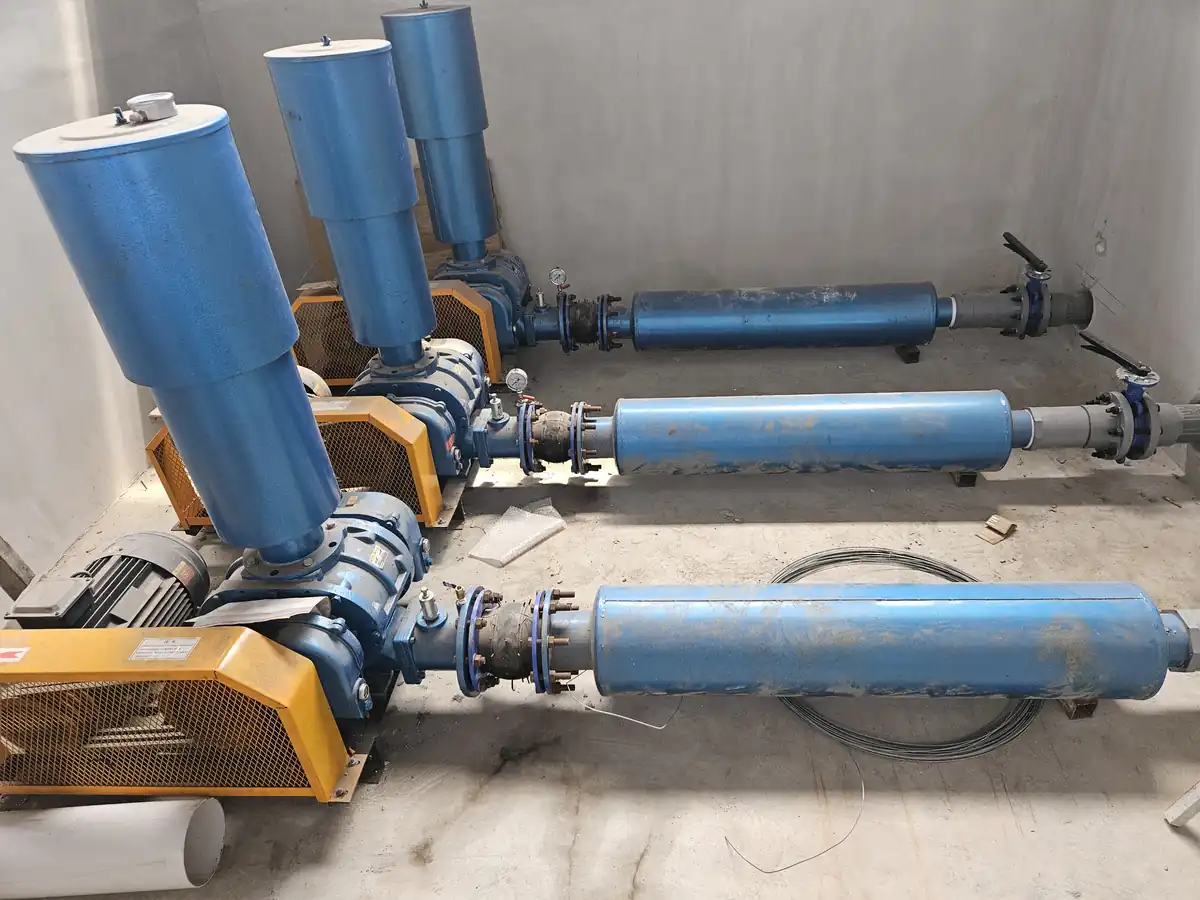
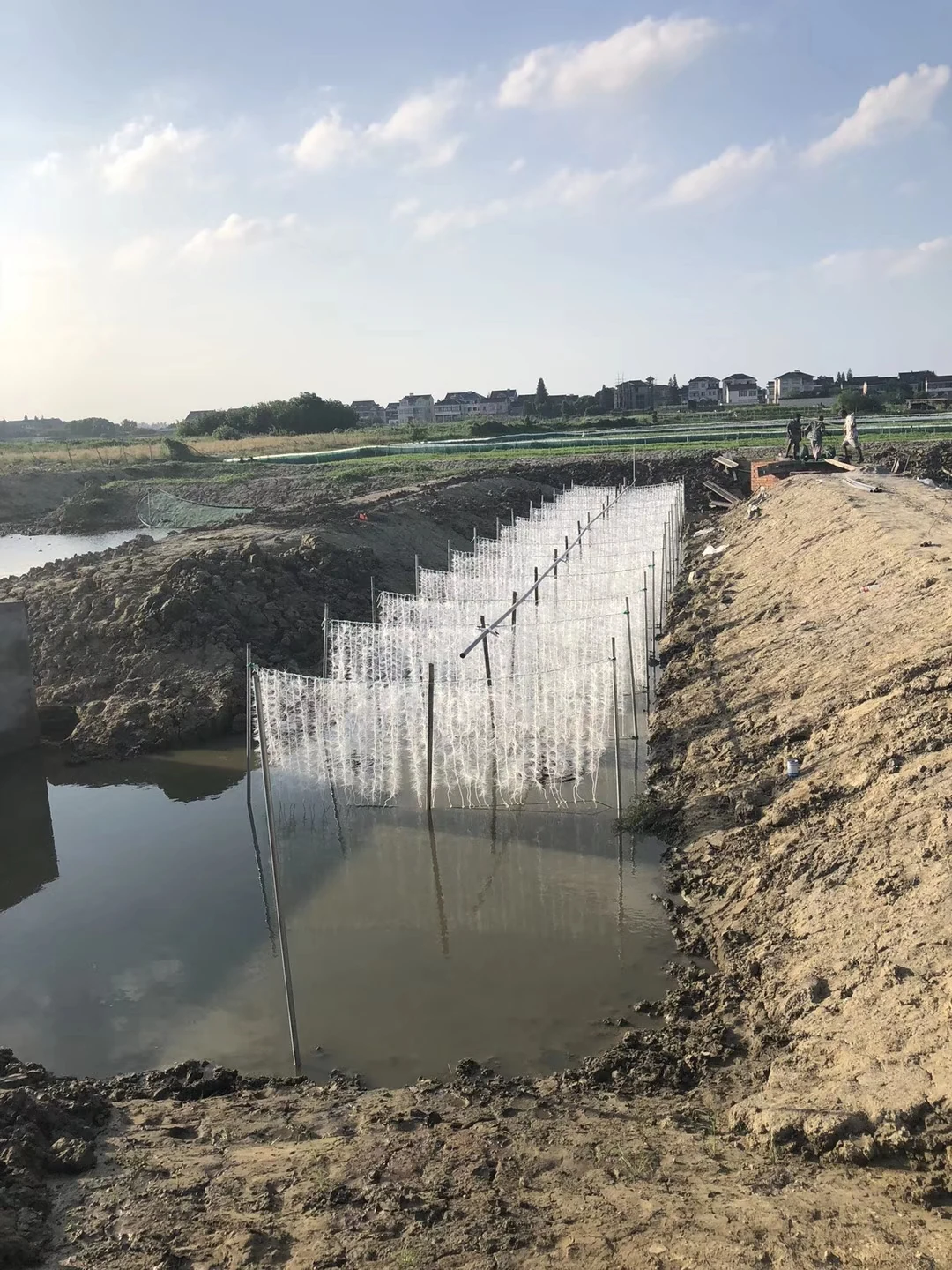
A microporous aeration system mainly consists of the main engine (electric motor), roots blower (1,400 r/min), air buffer tank, main pipe (PVC pipe), branch pipes (PVC pipe or rubber hose), aeration tubes (microporous nano aeration tubes) and aeration discs. The motor (power matched to the roots blower) drives the blower by belt; the blower connects to the air buffer tank; the tank connects to the main pipe; the main pipe feeds the branch pipes; and the branch pipes feed the aeration tubes. Two installation methods are common:
Disc installation
Allow 0.1-0.15 kW of blower power per mu. The disc frame can be made of 4-6 mm diameter steel bars, with the aeration tube fixed to the frame; a disc has a total tube length of 15-20 m. Install 3-4 discs per mu, or 2-3 discs with 30 m total tube length, fixed 10-15 cm above the pond bottom.
Strip (line) installation
Allow about 0.1 kW of blower power per mu. The total aeration tube length is about 60 m per mu, with about 10 m between tube rows. The height difference between rows must not exceed 10 cm, and the tubes are fixed 10-15 cm above the pond bottom.
The blower end of the system is covered separately: our page on the three-lobe roots blower walks through installation, start-up checks and daily operation.
Aeration timing through the season
Decide the aeration time and windows according to the dissolved-oxygen pattern of the water. Generally: in April-May, run the aerator at midnight on overcast or rainy days; in June-October, run it 2-3 hours in the afternoon and 2-3 hours starting about 1 hour before sunrise; during long overcast/rainy or low-pressure weather, run it from 21:00-22:00 at night until noon the next day; in the late culture period, run it frequently to promote growth. Where possible, measure dissolved oxygen and run the aerator accordingly, keeping the DO at 6-8 mg/L.
Maintenance checklist
The equipment itself is light, durable and simple to maintain, and most of what follows is inspection rather than repair.
1. Replace microporous tubes immediately if they rupture.
2. If algae stick to the tubes and block the micropores, dry the tubes in the sun for a day and tap them gently to shake off the attachments, or soak them in 20% laundry powder for 1 hour, rinse clean and dry before reuse.
3. Make sure the power box does not leak electricity.
4. Lubricate the roots blower regularly.
5. Protect against rust during the plum-rain (humid) season.
6. Protect against sun exposure in hot weather; build a shade canopy if needed.
7. Tighten any loose connections promptly.
8. At the end of the production cycle, dismantle the equipment and store it in the warehouse.
Beyond oxygen: self-purification and ecological balance
Oxygenating the bottom does more than raise a dissolved-oxygen number. Farmed water bodies are mainly oxygen-short at the bottom, where fat mud, organic waste and spoiled feed accumulate and consume oxygen continuously. Continuous microporous aeration converts that material into organic matter that micro-organisms can decompose, which restores the water's own self-purification ability — the layer surface-only aeration never reaches.
With dissolved oxygen sufficient throughout the column, the bacterial and algal populations stay naturally balanced and the water body settles into a working ecosystem rather than a managed one. The practical result is stock that survives and grows more reliably, which is what protects farming returns.
FAQ
Q: How much blower power does a microporous aeration system need per mu? A: Plan on 0.1-0.15 kW of blower power per mu for a 1-2 m deep pond: disc layouts use 0.1-0.15 kW per mu, strip layouts about 0.1 kW per mu with roughly 60 m of tubing per mu.
Q: How high above the pond bottom should the tubes be installed? A: 10-15 cm. Laid directly on the bottom, the tubes sink into sludge within a season and oxygen transfer drops sharply while the blower burns the same electricity.
Q: How long do microporous tubes last? A: Service life depends on water quality and handling, so the practical answer is that tubes are a consumable: inspect them each season, clean off algae that blocks the micropores, and replace any tube that has ruptured rather than patching it.
Q: Can one blower serve two ponds? A: Yes — size the blower for the combined tubing length of both ponds (roughly 1 kW per 100-150 m) and use valves on each branch so either pond can be isolated for maintenance.
Q: How much electricity does it actually save? A: Compared with traditional aeration methods for the same oxygen transfer, the 60-80% saving quoted in field practice comes from fine bubbles dissolving oxygen at the bottom instead of splashing water at the surface — the figure holds only when the system is sized to the pond rather than reused from a neighbour.