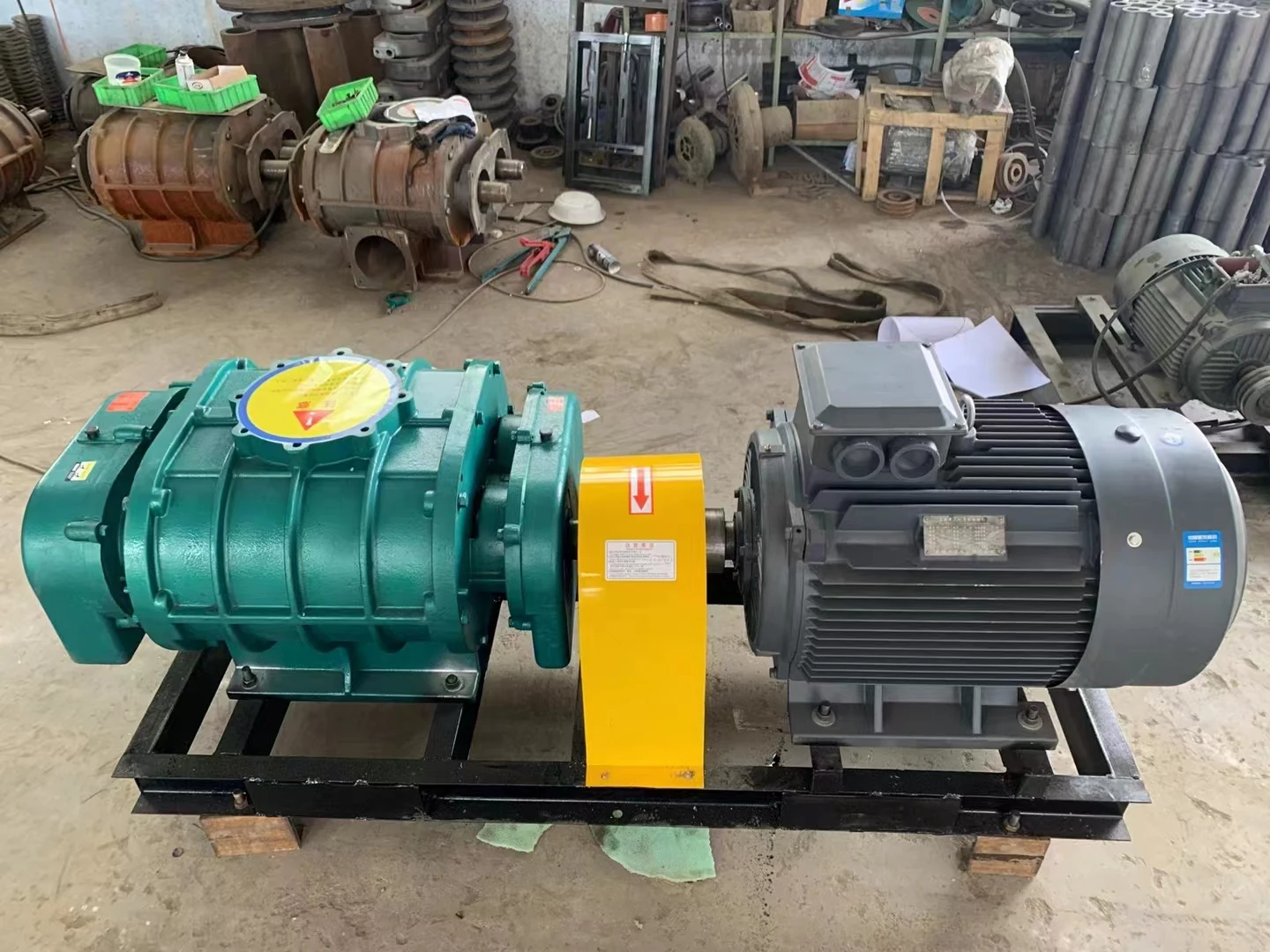
Commissioning a roots blower on a wastewater aeration system follows a fixed sequence: installation acceptance → check the starter cabinet wiring and switch to manual → open the discharge valve → jog the blower to confirm rotation direction → start the blower → check running condition and airflow (observe backwash air release) → check the discharge pressure transmitter and mechanical gauge → stop → switch the starter to auto → start/stop from the PLC panel or control-room station → switch the field cabinet to stop and confirm start/stop is disabled.
Pre-trial requirements
1. The bearing housing and oil tank must be cleaned and inspected, then filled with the lubricant grade and quantity specified in the technical documents.
2. The rotation direction of the motor (or turbine/exhaust driver) must match the technical documents.
3. Rotate the blower rotor by hand — it must turn freely with no friction or scraping.
4. The lubrication system and hydraulic control system must operate normally.
5. Safety, interlock, alarm and shutdown controls must pass a simulated test: cooling-system pressure not below its minimum; oil level and pressure not below minimums; bearing temperature and temperature rise not above maximums; bearing vibration velocity (RMS or peak-to-peak) within limits; surge alarms and relief devices responsive and reliable; blower speed not above the rated maximum.
6. All auxiliary units must pass individual trial runs.
7. Guards (covers/screens) must be fitted on exposed drive parts and the open atmospheric inlet.
8. The main air intake pipe and connected equipment must be clean.
Trial run requirements
- Open both the inlet and outlet valves fully before starting.
- Run empty (no load) with both valves fully open for at least 30 minutes.
- After a normal no-load run, slowly throttle the discharge valve until the design discharge pressure is reached; motor current must not exceed its rated value.
- During the loaded run, never close the inlet or outlet valves completely, never overload, always unload gradually before stopping — never stop suddenly at full load.
- Under load, run continuously for at least 2 hours after temperatures stabilize at rated speed and pressure: bearing temperature below 95 °C, lubricant temperature below 65 °C, and vibration velocity (RMS) not above 11.2 mm/s.
A disciplined commissioning run protects the blower, the warranty and the whole aeration process. For blower selection, installation guidance or parts, contact us with your project airflow and pressure requirements.
Frequently asked questions
Q: What sequence does commissioning follow? A: Installation acceptance, then check the starter cabinet wiring and switch to manual, open the discharge valve, jog the blower to confirm rotation direction, start it, check running condition and airflow, check the discharge pressure transmitter and mechanical gauge, stop, switch the starter to auto, start and stop from the PLC panel, then switch the field cabinet to stop and confirm start and stop are disabled.
Q: How long is the no-load run? A: At least 30 minutes, with both the inlet and the outlet valve fully open.
Q: What are the acceptance limits for the loaded run? A: After temperatures stabilize at rated speed and pressure, run continuously for at least two hours: bearing temperature below 95 °C, lubricant temperature below 65 °C, and vibration velocity (RMS) not above 11.2 mm/s.
Q: How should the blower be stopped? A: Unload gradually before stopping, and never stop suddenly at full load. During the loaded run the inlet and outlet valves must never be closed completely, and motor current must not exceed its rated value.
Q: What has to be checked before the trial run? A: Bearing housing and oil tank cleaned, inspected and filled to the specified grade and quantity; motor rotation direction matching the documents; rotor turning freely by hand with no friction or scraping; lubrication and hydraulic control working; safety, interlock, alarm and shutdown controls passing a simulated test; auxiliary units individually run; guards fitted on exposed drive parts and the open inlet; main intake pipe clean.