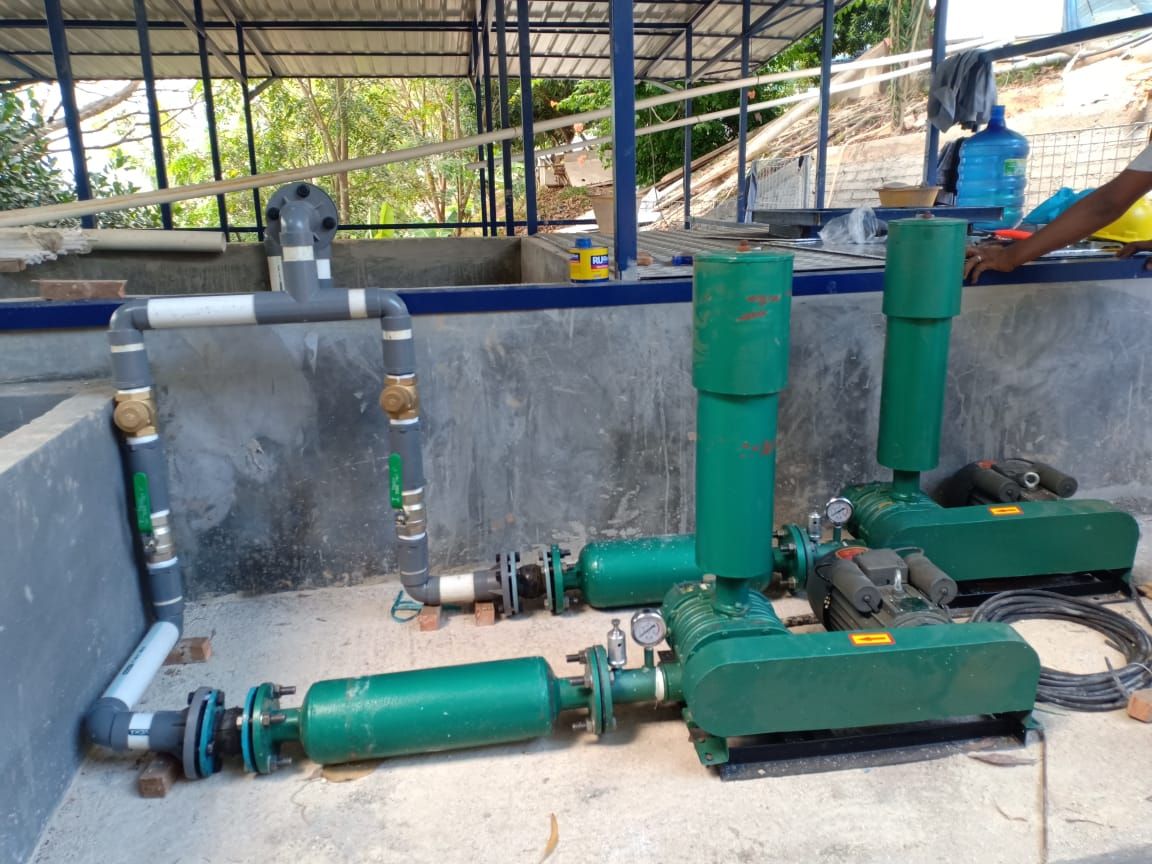
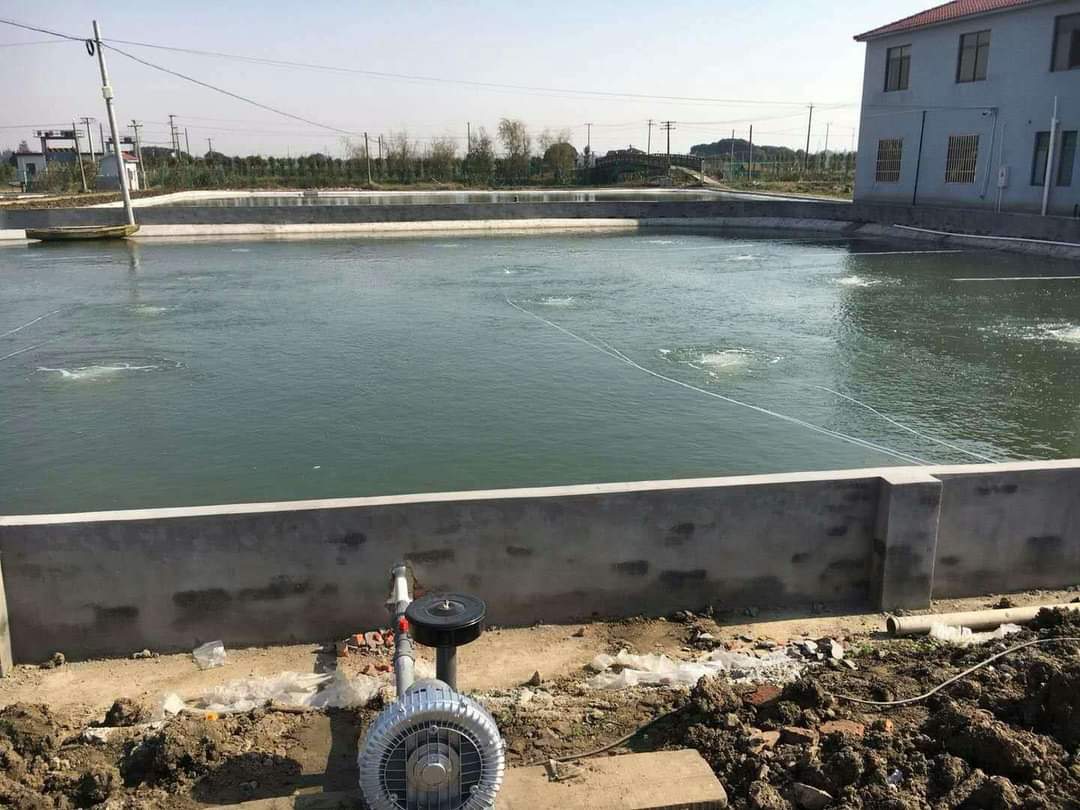
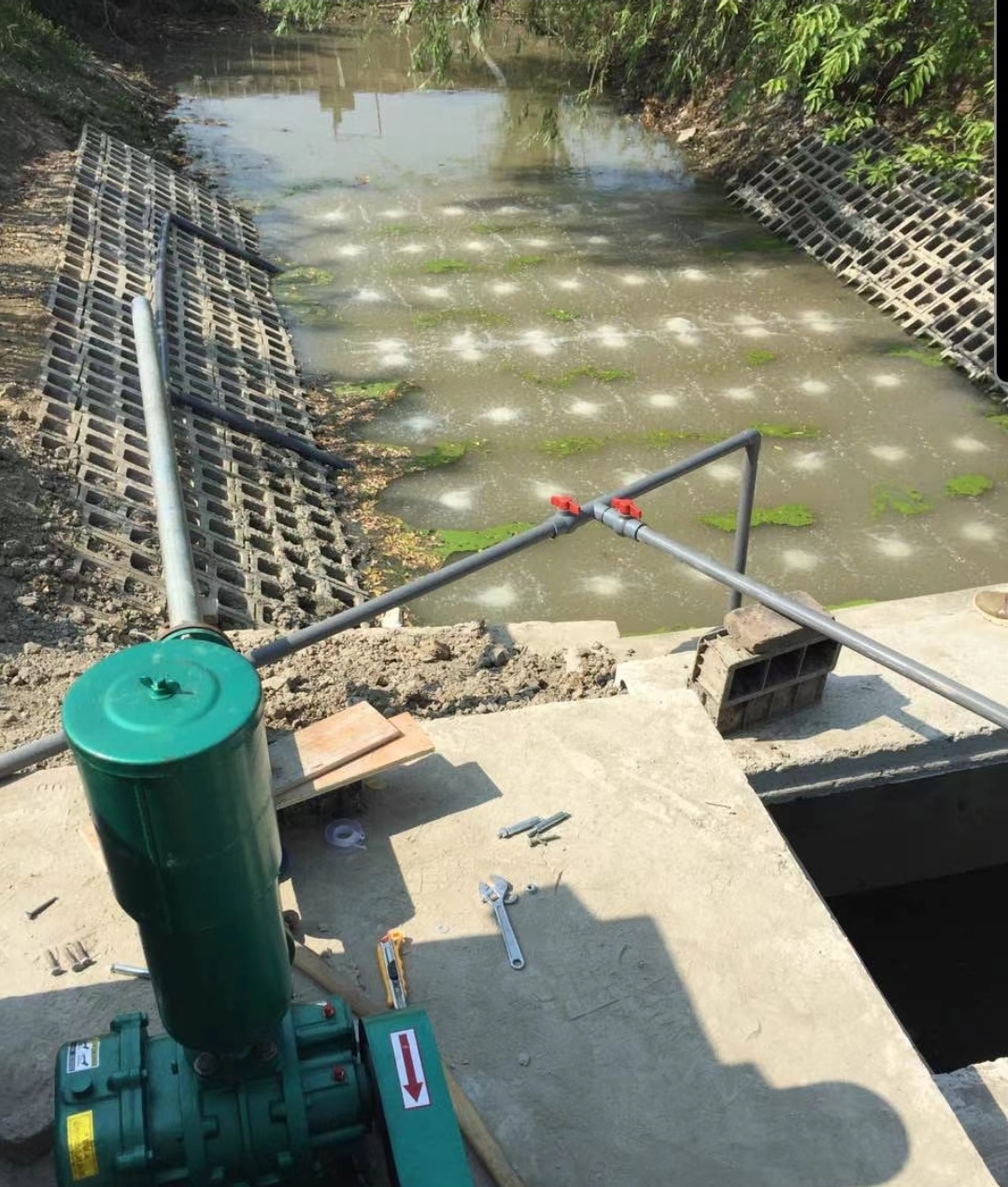
Quick answer: A roots blower for aquaculture is sized by three numbers - air flow (m³/min, driven by tubing length), pressure (kPa, driven by water depth), and power (kW). Work the five steps below, then confirm the exact model with the manufacturer. Two worked examples at the end show the full math.
Step 1 - Pond volume and target density
- Pond area in mu (1 mu = 667 m²) x average water depth (m) = volume (m³)
- Set your density class: low (<=0.15 kW/mu), medium (0.15-0.25), high (0.25-0.35). Shrimp at high stocking or biofloc go to the high end.
Step 2 - Tubing length
- Rule: 60-100 m of microporous tubing per mu, lines 3-5 m apart, laid 10-20 cm above the pond bottom.
- Example: 5 mu → 300-500 m. Use 400 m for the calculation below.
Step 3 - Air flow (m³/min)
- Microporous tube consumption: 0.002-0.006 m³/min per metre (fine pores, 1,000-1,600 holes/m).
- Flow = tube length x consumption per metre.
- Example: 400 m x 0.004 m³/min·m = 1.6 m³/min.
- Cross-check with the 1 kW per 100-150 m rule: 400 m → 2.7-4 kW (see Step 5).
Step 4 - Pressure (kPa)
- Static pressure ≈ water depth above the tubing: 1 m water ≈ 9.8 kPa. Tubing at 10-20 cm above the bottom in a 1.5 m pond → about 1.3-1.4 m of head ≈ 13-14 kPa.
- Add 10-20% for pipe, fitting and diffuser losses → ~16-17 kPa.
- Saltwater is ~2.5% denser - add a small margin for seawater ponds.
- Deep ponds (2.5 m+) and long mains need a blower with headroom: the ZXMSR series covers 9.8-98 kPa, so depth is rarely the limiter - but never undersize pressure.
Step 5 - Power and model (kW)
- Power follows the tubing: 1 kW per 100-150 m of tube.
- Example: 400 m → 2.7-4 kW → select a 3-4 kW class blower.
- Cross-check against the area rule: 5 mu x 0.15-0.35 kW/mu = 0.75-1.75 kW (low-density ponds can run leaner). Take the larger of the two methods - the tubing-based figure is the conservative one.
- The ZXMSR three-lobe roots blower line spans 0.6-136.7 m³/min, 9.8-98 kPa, 0.5-280 kW - your point will land somewhere in that range; the manufacturer's selection table converts it to a model number.
Worked example A - 5-mu tilapia grow-out pond
- Area 5 mu, depth 1.5 m → volume ≈ 5,000 m³; medium density.
- Tubing: 400 m (80 m/mu).
- Flow: 400 m x 0.004 = 1.6 m³/min.
- Pressure: head ≈ 1.35 m → 13.2 kPa + 15% losses ≈ 15-17 kPa.
- Power: 400 m ÷ 125 m/kW ≈ 3.2 kW → 3-4 kW class.
- Check: 5 mu x 0.2 kW/mu = 1.0 kW < 3.2 kW → keep 3-4 kW (tubing method wins; the extra capacity buys headroom for hot-season DO dips).
Worked example B - 10-mu semi-intensive shrimp pond
- Area 10 mu, depth 1.8 m → volume ≈ 12,000 m³; high density (shrimp).
- Tubing: 800 m (80 m/mu).
- Flow: 800 m x 0.004 = 3.2 m³/min.
- Pressure: head ≈ 1.6 m → 15.7 kPa + 15% losses ≈ 18-20 kPa.
- Power: 800 m ÷ 125 m/kW ≈ 6.4 kW → 7.5 kW class.
- Check: 10 mu x 0.3 kW/mu = 3.0 kW < 6.4 kW → keep 7.5 kW.
Three mistakes that cost farms money
1. Sizing by area only (0.15 kW/mu) and skipping tubing length - under-aerates the far end of the pond.
2. Ignoring pressure - a blower rated for shallow tanks starves deep ponds and long mains.
3. Buying a blower with no headroom - the hottest month's DO dip is exactly when you need 20% reserve.
FAQ
Q: How many kW do I need per mu? A: 0.15 kW/mu (low density) to 0.35 kW/mu (high density shrimp/biofloc); cross-check with 1 kW per 100-150 m of tubing.
Q: How deep should the tubing sit? A: 10-20 cm above the bottom - high enough to avoid sediment, low enough to oxygenate the benthic layer.
Q: Roots blower or regenerative blower? A: Roots (9.8-98 kPa) for ponds deeper than about 1.5 m or long mains; regenerative blowers top out at much lower pressure. See the full comparison in the equipment guide.
Q: Can one blower feed multiple ponds? A: Yes - size flow as the sum of tubing, keep mains short and balanced, and add a valve per pond.
Q: What if my pond is 2.5 m deep? A: Add about 10 kPa of head vs a 1.5 m pond; check the blower's pressure rating, not just flow.
Q: Do I need a VFD? A: Not to size correctly, but a variable frequency drive cuts 15-25% of energy and soft-starts the motor - worthwhile at 3 kW and above.
CTA
Still unsure? Send us your pond area, depth and species - we reply with a matched system (blower + tubing + fittings) from the factory, sized for your water and voltage. Contact us · Browse roots blowers · See also the quick selection guide and our installation guide.