The Short Answer
Tilapia tolerate lower oxygen than shrimp, but high-density tilapia farming still requires bottom aeration: hold 3–5 mg/L at the bottom and treat anything under 2 mg/L as dangerous. On a typical 1–2 m grow-out pond, run microporous aeration tubing fed by a roots blower (1 kW per 100–150 m of tubing) and aerate 15–20 h/day in the growing season, watching the pre-dawn hours. Size from ≈0.15 kW per mu (≈0.9 kW per acre) plus stocking density, not surface area alone.
Tilapia vs. Shrimp: Different Oxygen Needs
| Band | Tilapia | Shrimp (L. vannamei) |
|---|---|---|
| Target — full growth and feed conversion | 3–5 mg/L | 4–6 mg/L |
| Stress — growth and FCR drop | below 3 mg/L | below 4 mg/L |
| Minimum — survival at risk | ~2–3 mg/L | ~3–4 mg/L |
| Aeration mandatory at | High density (>5 kg/m³) | Any commercial density |
| Main risk at low DO | Slow growth, disease | Acute mortality |
Read that table as two thresholds: tilapia must stay above 3 mg/L, shrimp above 4 mg/L. Tilapia forgive a bad night that would kill a shrimp crop; they do not forgive a bad month. "Robust" means survival, not performance — below 3 mg/L feed conversion drops and bacterial disease pressure rises, and in high-density ponds (5–15 kg/m³) the gap between 3 and 5 mg/L is measurable profit.
Pond Setup for Aeration
Depth and shape
1.5–2 m water depth is the sweet spot: deep enough for temperature stability, shallow enough that bottom aeration stays efficient.
Aeration configuration
Two rules drive the table: ≈0.15 kW per mu (≈0.9 kW per acre) and 1 kW of motor per 100–150 m of tubing.
| Pond size | Tubing length | Blower power | ZXMSR band |
|---|---|---|---|
| 1–3 mu (0.16–0.49 acre) | 30–50 m | ≈0.15–0.45 kW | smallest model (0.5 kW) |
| 3–5 mu (0.49–0.82 acre) | 50–80 m | ≈0.45–0.75 kW | small (0.5–1.5 kW) |
| 5–10 mu (0.82–1.65 acre) | 80–150 m | ≈0.75–1.5 kW | small to medium (1.5 kW) |
| 10–20 mu (1.65–3.3 acre) | 150–300 m | ≈1.5–3 kW | medium to large (2.2–3.7 kW) |
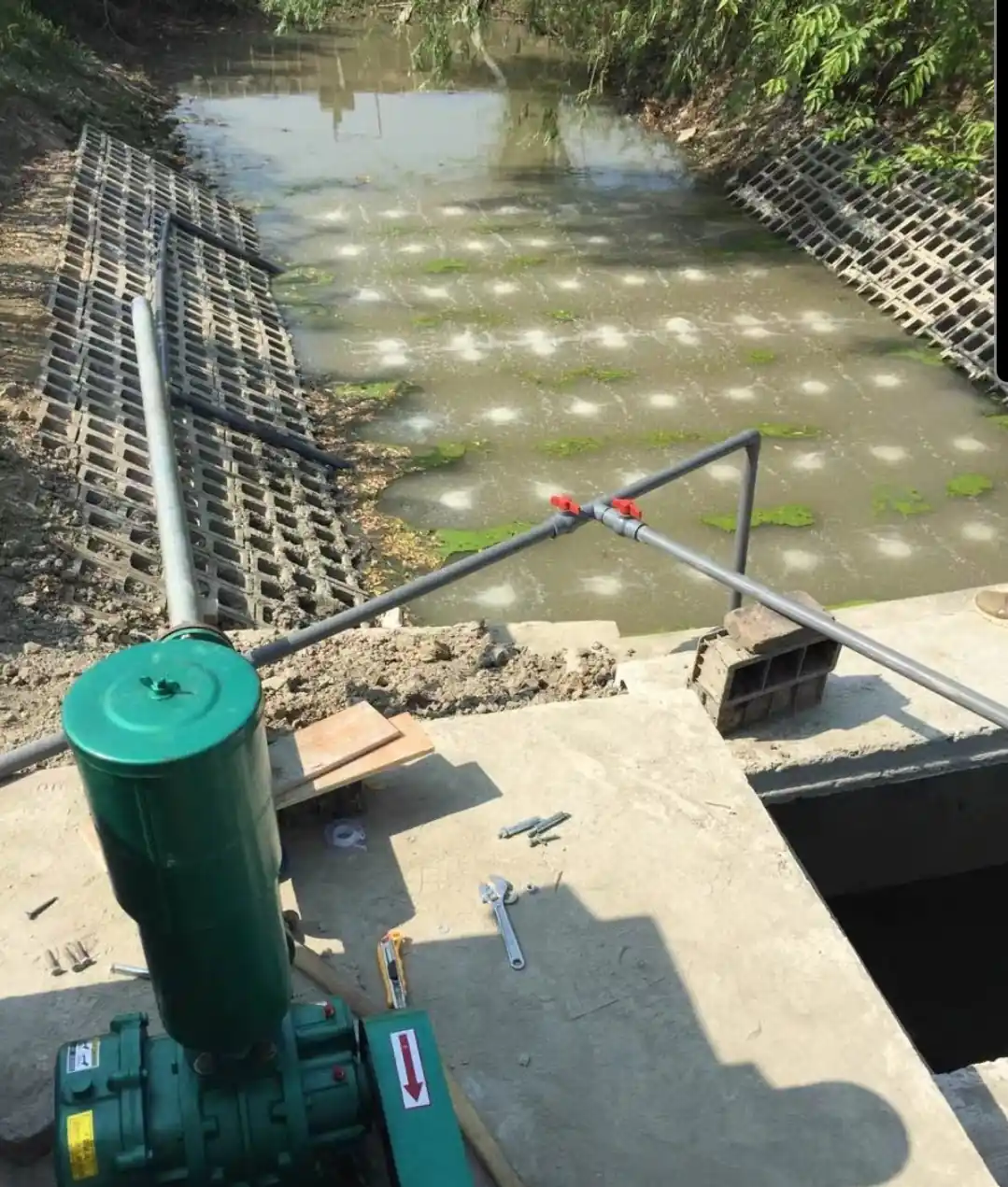
Lay parallel lines 3–5 m apart, 10–20 cm above the bottom, fed from one manifold with isolation valves. (1 mu ≈ 667 m²; 1 acre = 6.07 mu = 4,047 m².) Check the airflow too: air demand ≈ tubing length × 0.1–0.4 m³/h per metre, so 150 m at 0.2 m³/h·m needs about 30 m³/h. Pressure is depth plus 15–20% headroom — a 3 m pond needs 0.35–0.45 bar, inside the 9.8–58.8 kPa band of a roots blower.
Backup
A spare blower is cheap insurance against a pre-dawn outage; off-grid ponds cover it with a solar or diesel source at about 1 kW of panel per kW of blower.
How Many Aerators for a Tilapia Pond
Area gives the baseline, density overrides it, depth decides the machine.
Area. Budget ≈0.15 kW per mu (≈0.9 kW per acre), or 90–120 m of tubing per acre — about 0.45 kW and 30–50 m for 0.5 acre, 0.9 kW and 80–150 m for 1 acre, 1.8 kW and 160–300 m for 2 acres, and 4.5 kW for 5 acres split into blocks. A floating unit instead covers 4–12 mu (0.66–2 acres) at 1.5–3 kW, so one unit suits 1 acre while 5 acres needs about three.
Density. Oxygen demand tracks feeding, and feeding tracks biomass: a pond carrying 1,000 kg of stock per mu consumes oxygen at a rate a lightly stocked pond never reaches. The 0.15 kW/mu figure assumes a moderate stocking rate; at 5–15 kg/m³ step capacity up from it.
Depth. The same acre at 1 m and at 3 m is not the same purchase: deeper water needs more pressure and carries a larger oxygen debt. Above 2 m, diffused aeration wins whatever the area, because it reaches the layer tilapia use at night.
Pump or Aerator? What Each One Actually Does
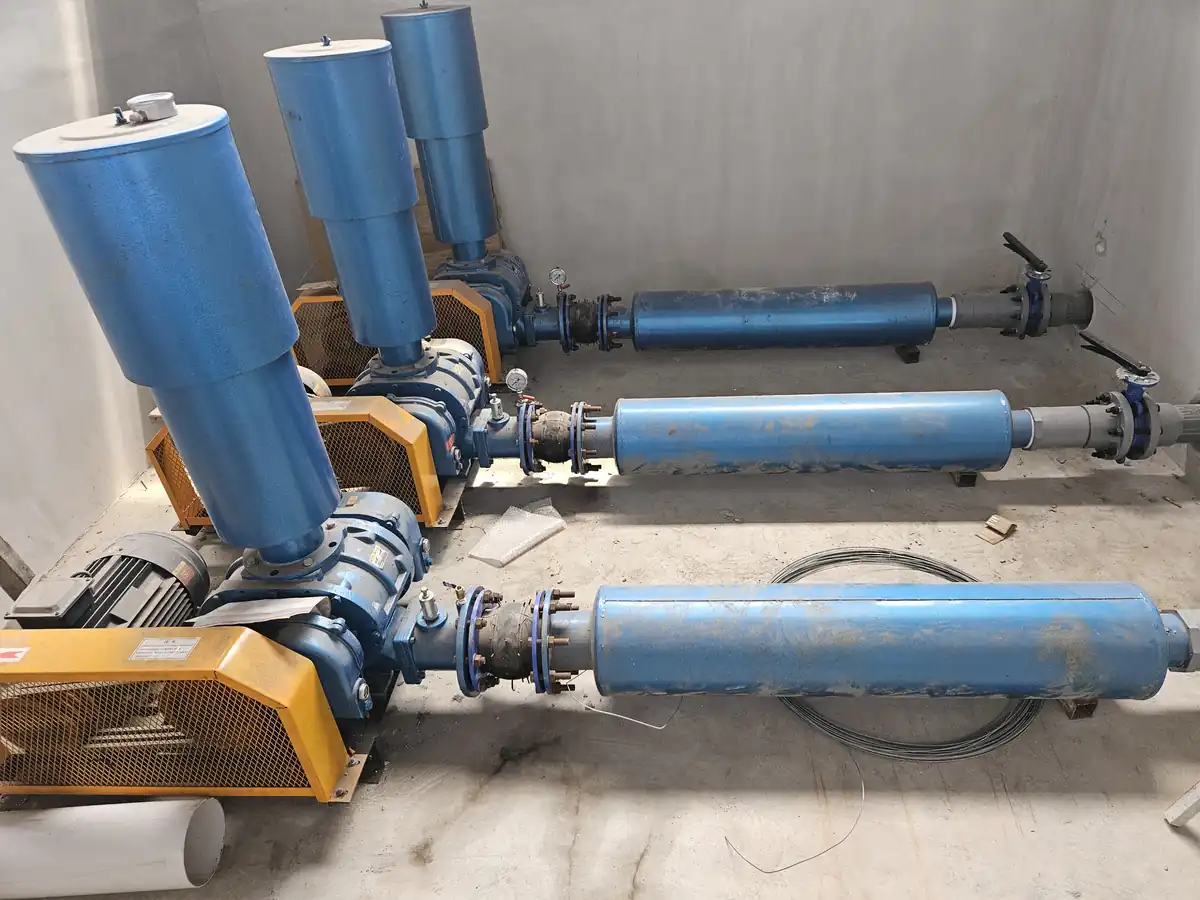
A water pump moves water; an aerator transfers oxygen. Circulation redistributes oxygen already in the pond but adds none, and overnight it cannot keep up with what fish and sludge consume. So the "pump" in a diffused aeration system is an air pump — in practice a roots blower, which pushes air, not water, down to diffusers on the pond floor.
- Water pump: filling, draining, moving stock, water exchange.
- Aerator: holding the pre-dawn dissolved oxygen floor above 3 mg/L — the job that limits stocking density.
- Do not substitute one for the other. A water pump running all night is not aeration.
Diffused aeration also transfers the same oxygen at 0.15 kW per mu with 1 kW per 100–150 m of tubing — under a quarter of the energy a paddle-wheel or impeller machine uses. A surface pond aerator still earns its place as emergency backup, but as routine duty the diffused system usually wins.
Daily DO Management (The Practical Routine)
The daily cycle in tilapia ponds
| Time | DO pattern | Action |
|---|---|---|
| 3–7 am | Lowest | Aeration running; watch for fish gasping at the surface |
| Morning | Rising | Check DO, start feeding when DO > 3 mg/L |
| Afternoon | Highest | Peak photosynthesis; can reduce aeration |
| Evening | Falling | Full aeration on; feed earlier rather than late |
Sampling the pre-dawn minimum
The number that matters is the day's lowest, and it happens before sunrise.
1. Measure between 5 and 6 am, at the bottom. A reading at 8 am always looks better than the truth, and surface readings can be double the bottom value.
2. Sample the same two or three spots daily — the deepest point and the corner furthest from the diffusers.
3. Track the trend. One morning at 3.2 mg/L is fine; 2.9, then 2.7, then 2.4 over three mornings is a system losing ground.
Practical rules
1. Aerate 15–20 h/day in the growing season — more in hot or cloudy weather.
2. Feed by DO, not by clock: skip feeding below 3 mg/L; feed adds oxygen demand.
3. Watch the weather: cloudy days cut photosynthesis, so run aeration more, not less.
Common Mistakes in Tilapia Pond Aeration
1. No aeration because "tilapia are hardy" — hardy means survival, not growth.
2. Aerating only at night — daytime aeration improves feed conversion and prevents afternoon stratification.
3. Sizing by area while ignoring biomass and depth — a high-density 3-mu pond needs more aeration than a low-density 10-mu pond, and depth sets the pressure the blower must hold, so a shallow-pond calculation under-sizes a deep pond of the same area.
4. Ignoring the bottom — surface aeration leaves the bottom, where tilapia rest at night, under-oxygenated.
Warm-Season vs Cool-Season Running Hours
| Season | Main purpose | Running hours |
|---|---|---|
| Warm season (growing) | Hold the pre-dawn DO floor so fish keep growing | 15–20 h/day, pre-dawn always covered |
| Shoulder season (spring / autumn) | Same purpose, less help from algae | Trim daytime hours, keep the pre-dawn window complete |
| Cool season / winter | Mix the water column so the pond warms evenly | Shift hours to the warmest part of the day |
In the growing season photosynthesis is strong, so afternoon DO runs high and the risk sits in the pre-dawn hours. Winter is a different job: surface water can reach 10–15 °C while 30–40 cm below it is still very cold, and without circulation the cold bottom layer stays put, stratifying the pond and suppressing feeding. Two winter rules: switch the aerator off while the fish feed, and raise the water level above 1.5 m before a cold snap so the bottom layer stays above 4 °C. On a standard 1–2 m pond a 1.5–2.2 kW blower is enough for mixing.
Frequently Asked Questions
Q: How much DO do tilapia really need? A: Target 3–5 mg/L. Growth slows below 3 mg/L and mortality risk rises below 2 mg/L.
Q: Do I need aeration if I only stock low density? A: Below ~2 kg/m³ with good water exchange, natural oxygen may suffice. Above that, aeration pays for itself in growth and feed conversion.
Q: Paddle wheel or bottom aeration for tilapia? A: Bottom aeration oxygenates where tilapia rest at night and uses less energy; paddle wheels suit backup and circulation.
Q: How do I know my aeration is enough? A: Bottom DO stays 3–5 mg/L through the pre-dawn minimum and fish feed normally by morning. If DO crashes at dawn, increase aeration or cut stocking.
Q: Can one blower serve several tilapia ponds? A: Yes, with a correctly sized manifold and isolation valves. Size the blower for total tubing length and the deepest pond's pressure.
Q: What size aerator does a 1-acre tilapia pond need? A: Diffused: about 0.9 kW of blower with 90–120 m of tubing. Surface: one 1.5–2.2 kW floating unit, since each covers 4–12 mu.
Q: How many hours a day should I run a tilapia pond aerator? A: 15–20 h/day in the growing season, with the pre-dawn hours always covered. In winter, shift the hours to the warmest part of the day.
Q: Does a tilapia pond need aeration in winter? A: Yes, but for a different purpose: mixing the water column so the pond warms evenly. Keep an ice hole open and switch the aerator off while the fish feed.
The Bottom Line
Tilapia's oxygen tolerance buys you margin, not freedom from aeration. In high-density grow-out, bottom aeration at 3–5 mg/L DO converts directly into faster growth, better feed conversion and lower disease losses.
Zhongxin Machinery supplies complete pond aeration systems for tilapia — roots blowers, microporous aeration tubing, manifolds and layout drawings — sized to your pond area, depth and stocking density.