Quick Answer: Sizing a pond aerator takes two numbers: pond area and water depth. For diffused (microporous) aeration, budget ≈0.15 kW per mu (≈0.9 kW per acre) and 1 kW per 100–150 m of tubing; a floating aerator covers 4–12 mu (0.66–2 acres) per unit at 1.5–3 kW. Pressure must cover water depth plus 15–20% headroom.
What a pond aerator actually does
A pond aerator does not simply stir the surface. Its job is to move oxygen into the water layers that consume it fastest — the bottom metre, where sludge, uneaten feed and faeces break down and strip oxygen out of the water all night.
That is why the daily oxygen minimum arrives just before sunrise, after a full night of respiration with no photosynthesis to offset it — a pond can read 8 mg/L in the afternoon and still be in trouble at 5 AM.
Two thresholds decide whether a pond is safe. They come from our own product specifications, not from a textbook:
| Species | Safe pre-dawn dissolved oxygen | What happens below it |
|---|---|---|
| Tilapia | above 3 mg/L | feeding response drops, growth stalls, condition is lost |
| Shrimp (vannamei and similar) | above 4 mg/L | stress at moulting, poor survival, sudden crashes |
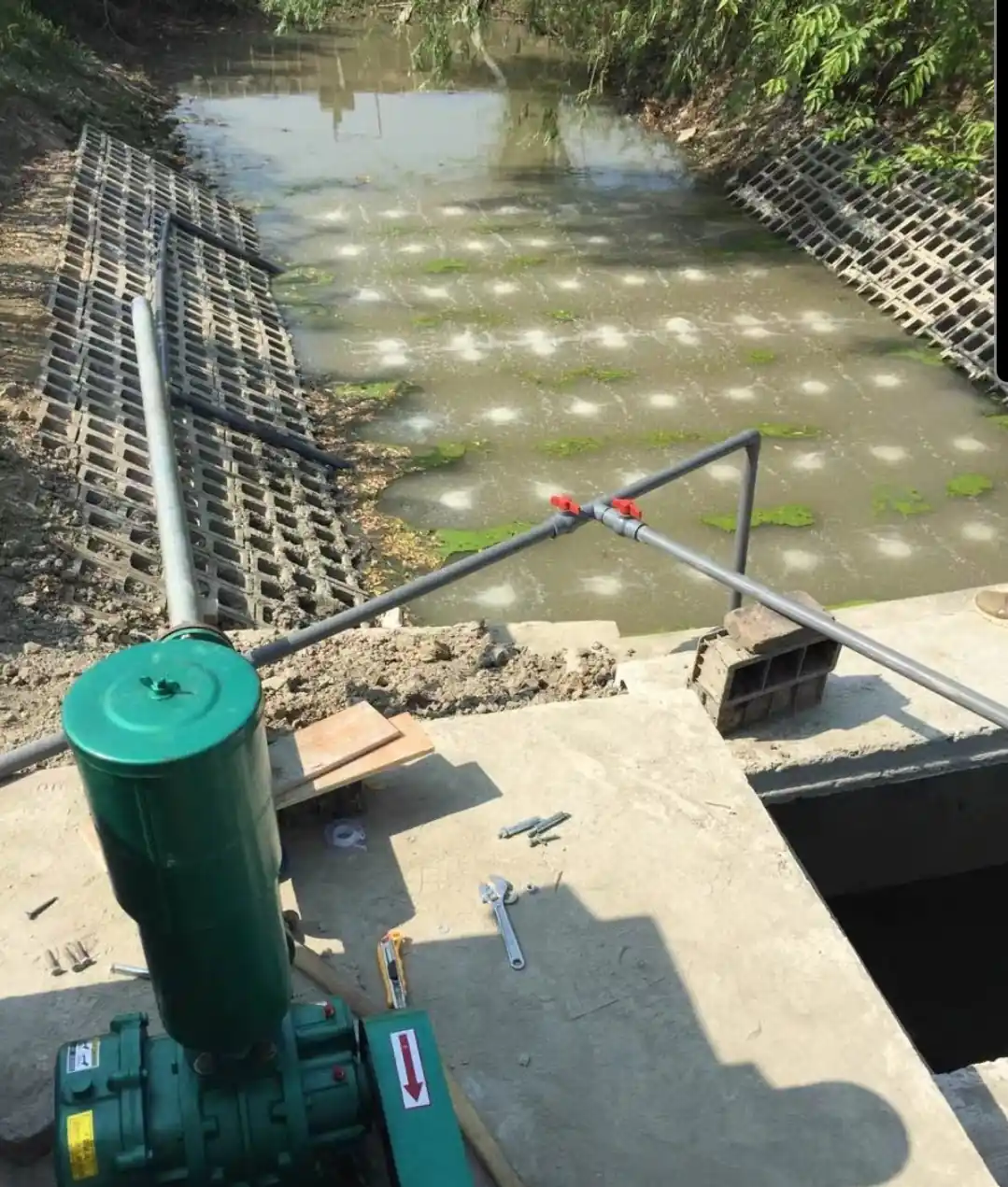
Diffused (microporous) aeration changes the picture at the bottom of the pond, which is where the deficit lives. Because the bubbles are released at depth and dissolve as they rise, the bottom layer can be held at roughly 4.5 mg/L — while the energy needed is less than a quarter of what a paddle-wheel or impeller aerator burns for the same amount of oxygen transferred.
That is the argument for choosing a type before choosing a size: in a deep or heavily stocked pond, surface machines work on the wrong layer.
| Water layer | Typical summer profile before aeration | After diffused aeration |
|---|---|---|
| Surface (0–0.5 m) | Highest in the pond — wind mixing plus daytime photosynthesis | Highest |
| Middle (1–2 m) | Markedly lower, and out of reach of surface machines | Closer to the surface reading |
| Bottom (2 m and below, above the sludge) | Lowest — the layer where demand outruns supply | Held at roughly 4.5 mg/L |
The shape is the point: evening out that profile, rather than adding more splash at the top, is what keeps the bottom layer alive.
The four pond aerator types compared
| Type | How it works | Typical power | Coverage per unit | Best for | Relative energy |
|---|---|---|---|---|---|
| Floating / impeller | Sits on the surface, impeller throws and circulates water | 1.5–3 kW | 4–12 mu (0.66–2 acres) | Larger ponds, fast emergency response | Medium–high |
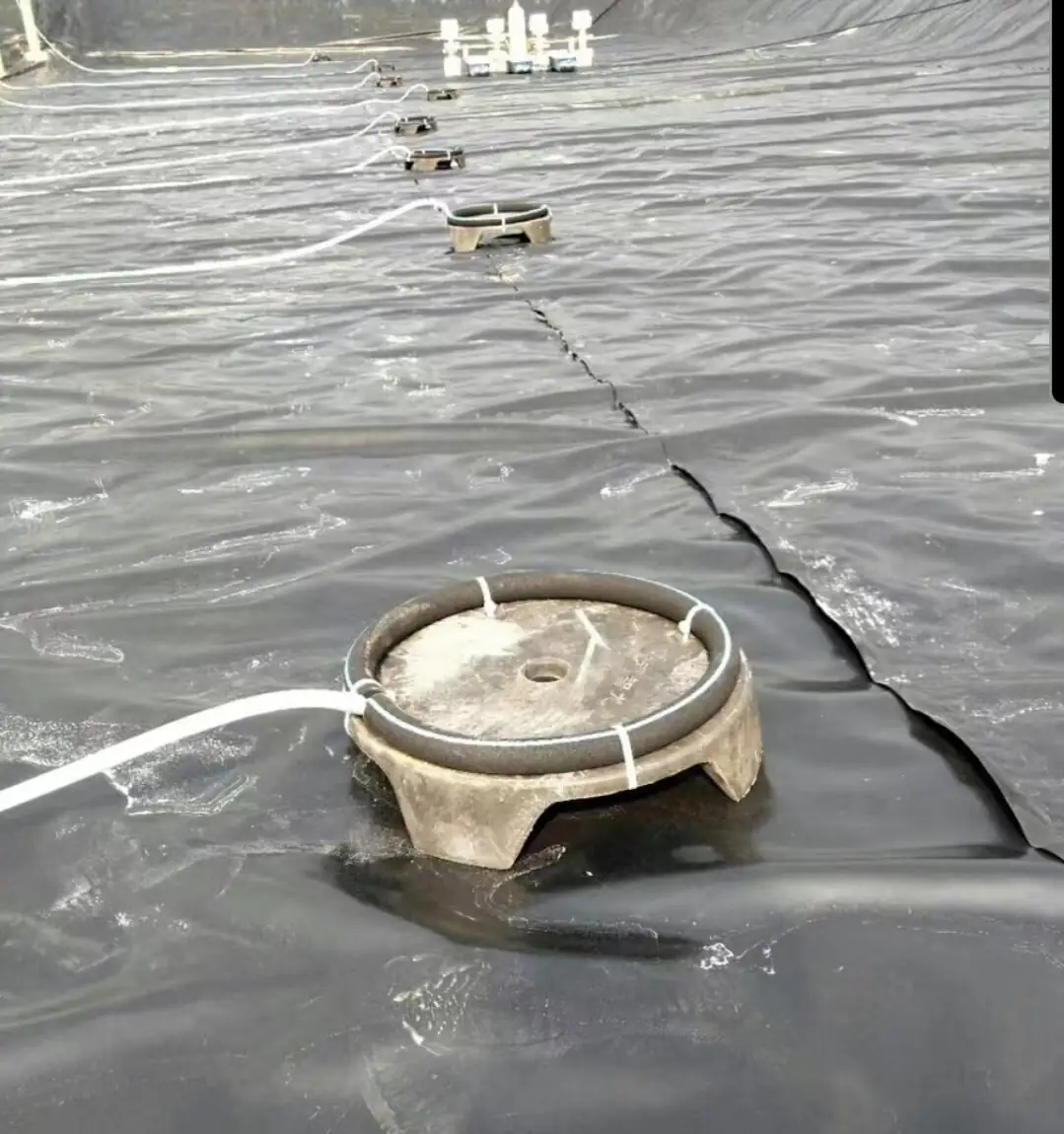
| Diffused (microporous) | Microporous tubes or discs on the pond bed release 0.3–2 mm bubbles | ≈0.15 kW per mu | By tubing length (1 kW ↔ 100–150 m) | High density, deep water, electricity cost matters | Lowest (<1/4) |
| Paddle wheel | Paddle wheel churns the water surface | — | — | Traditional shrimp ponds | High |
| Nano tube / disc diffuser | Finer-pore microporous diffuser, 0.5–3 mm (seawater) | Same as microporous | Same as microporous | Seawater and clog-sensitive sites | Low |
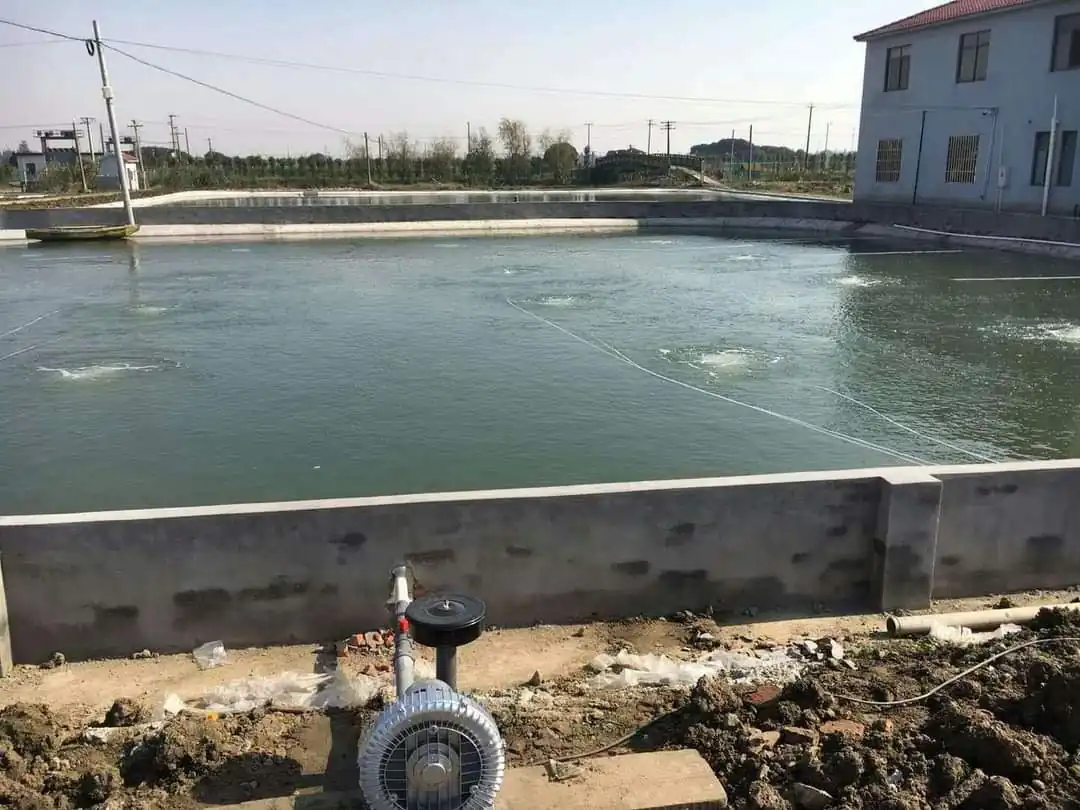
The two surface types are what most farms start with, because they are the cheapest way to see a result this season. The diffused types are where farms move once the sludge layer builds up and electricity becomes the largest operating cost. Our floating aerators page lists the impeller models, and the microporous aeration system page covers the tubing and disc side.
If you go the diffused route, these are the published specifications the sizing depends on:
- Bubble size: 0.3–2 mm in fresh water, 0.5–3 mm in seawater
- Pore density: 1,000–1,600 pores/m
- Air flow per metre of tube: 0.002–0.006 m³/min·m
- Sizing rule: 1 kW of blower per 100–150 m of tubing, ≈0.15 kW per mu
- Working depth 0–5 m, supply pressure 0.05–0.10 MPa
- Tube roll lengths: 1,500–2,500 m / 2,500–4,000 m / 4,000–5,000 m
How to size a pond aerator: the four numbers that decide it
Pond aerator sizing comes down to four numbers. Each one changes the machine you need, so work through them in order rather than jumping straight to a power rating.
Step 1 — Measure area and depth
Area sets the oxygen demand; depth sets the pressure. Both are needed, and skipping the second is the single most common sizing mistake we see on farms — a shallow pond and a deep pond of the same surface area need completely different machines.
Work in whichever unit you already use, but keep the conversion to hand:
1 mu = 667 m² | 1 acre = 6.07 mu = 4,047 m²
Step 2 — Estimate power from area
For diffused aeration the working figure is ≈0.15 kW per mu, which is ≈0.9 kW per acre.
For floating units, size by the coverage rating rather than by a per-area formula: one machine covers 4–12 mu (0.66–2 acres) depending on the model, at 1.5–3 kW.
Step 3 — Set the pressure from the depth
Pressure is what pushes the air down to the diffusers, so it must be computed from the water column, not guessed:
Required pressure = water depth + 15–20% headroom
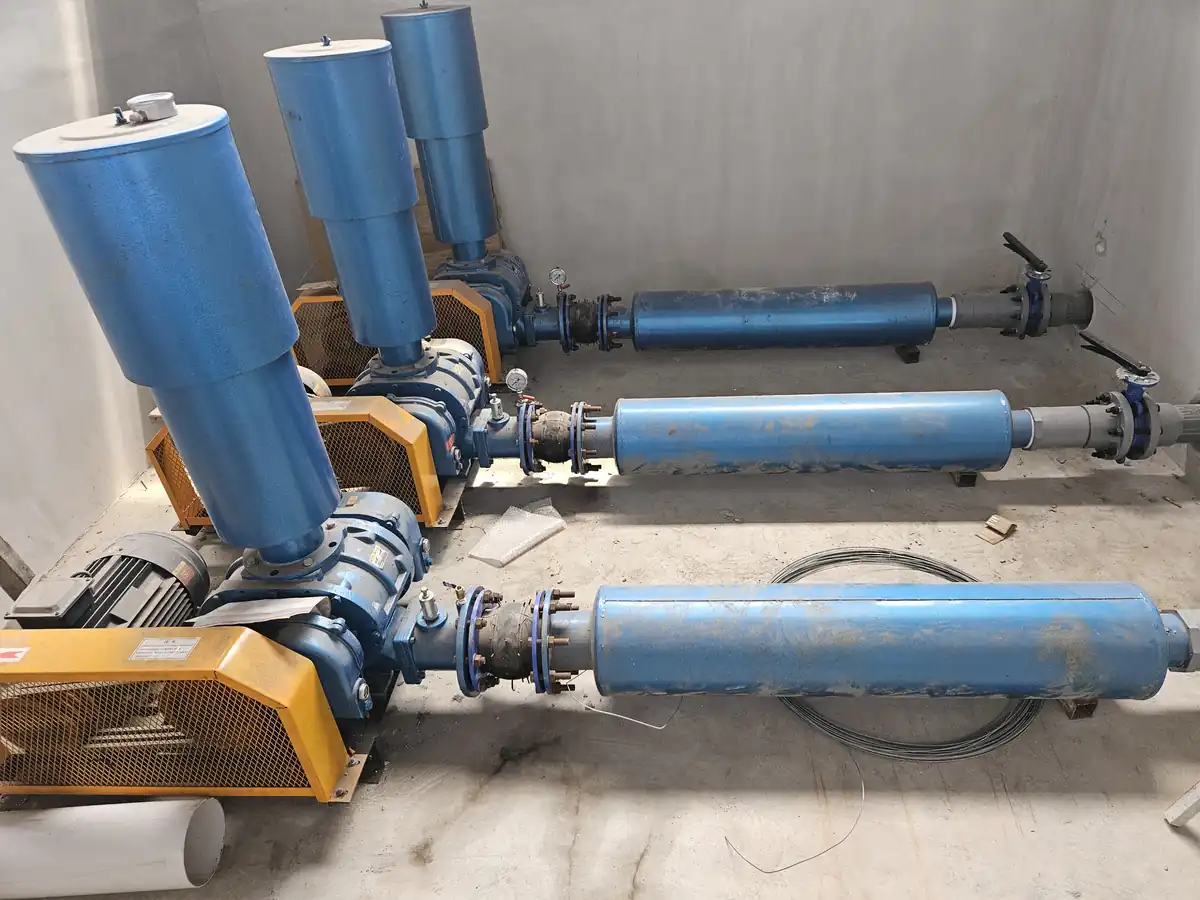
A 3 m pond therefore needs roughly 0.35–0.45 bar. Our roots blower range is specified at 9.8–58.8 kPa as standard, with high-pressure models up to 98 kPa — and the models offered run from 0.6 to 136.7 m³/min across 0.5–280 kW, in three practical bands for pond work: small 0.5–1.5 kW, medium 1.5–2.2 kW, large 2.2–3.7 kW.
A blower rated for the airflow but not for the required depth delivers less air than its nameplate promises.
Step 4 — Calculate tubing length and air demand
Tubing length follows from the power you chose in Step 2, using the 1 kW ↔ 100–150 m rule. Lay the runs 3–5 m apart and fix them 10–20 cm above the pond bottom — on the bottom they sink into sludge within a season.
Practical lengths by scale:
- 30–50 m of tubing for 1–3 mu
- 50–80 m for 3–5 mu
- 80–150 m for 5–10 mu
Then convert tubing length into the airflow the blower must actually supply:
Air demand = tubing length × 0.1–0.4 m³/h·m
So 150 m at 0.2 m³/h·m gives 30 m³/h, or 0.5 m³/min FAD. That is the number to quote when you ask for a blower: it lets a supplier match a model to your pond rather than to its area alone. Any pond aeration systems enquiry we answer starts from air volume and required pressure; our installation guide covers layout and fixing on site.
How many pond aerators per acre?
Diffused systems are sized by tubing length and blower power; floating units are counted in machines. This table derives both from the rules above — treat the figures as planning numbers to confirm against your own area, depth and density:
| Pond size | Diffused (microporous) | Floating aerator |
|---|---|---|
| 0.5 acre (3 mu) | 0.5 kW blower + 45–60 m tubing | 1 × 1.5 kW (BYL-1.5) |
| 1 acre (6.07 mu) | ≈0.9–1 kW blower + 90–120 m tubing | 1 × 2.2 kW (BYL-2.2, covers 6–10 mu) |
| 2 acres (12 mu) | ≈1.8–2 kW + 180–240 m | 1 × 2.2–3 kW (TSBYL-2.2-3.0) |
| 5 acres (30 mu) | ≈4.5 kW + 450–600 m | 2–3 × 2.2–3 kW |
| 10 acres (61 mu) | ≈9 kW + 900–1,200 m | 5–6 × 2.2–3 kW |
Two adjustments matter more than the table itself.
First, high-density operations and shrimp ponds should scale up by 20–30% on top of these figures. A pond carrying 1,000 kg of stock per mu consumes oxygen at a rate a lightly stocked pond never reaches.
Second, don't size from surface area alone. A 1-acre pond 1 m deep and a 1-acre pond 3 m deep look identical from the bank but need different machines: the deeper one needs more pressure, and its bottom layer holds a larger oxygen debt.
What your sizing choices add to the cost
The full cost breakdown belongs to the price guide. What matters here is narrower: which of your sizing decisions move the number.
The power band. 1.5 kW, 2.2 kW and 3 kW are the practical steps for floating units. Stepping up one band raises the unit price but reduces the count you need, so price the system for the pond rather than the machine.
The voltage. A 380 V three-phase model and a 220 V single-phase model of the same 1.5 kW aerator are not the same purchase. Single-phase is what you buy when the farm has no three-phase supply; it also means lower oxygenation output at the same motor rating. In our published range, the 1.5 kW impeller delivers 3.5 kg/h on 380 V three-phase and 3.0 kg/h on 220 V single-phase.
The drive. An external VFD lets a standard motor run at reduced speed to match demand through the day, cutting energy when the pond does not need full output. An integrated permanent-magnet synchronous machine (PMSM) removes slip losses at the motor and needs no separate cabinet. For VFD floating units the published figures are 1.5–3 kW (4 kW / 5 HP input available), 220–380 V / 50 Hz, 4–12 mu per unit, ≈3 kg/h, in a 60×60×35 cm frame at roughly 30 kg gross.
Tubing and diffuser count, and the freight terms. Length of tubing, number of discs and the Incoterms you ask for (FOB or CIF) are part of the delivered figure.
For the full cost breakdown by block, see our aerator price guide.
Matching the pond aerator to your species and stocking density
The best pond aerator for fish pond stocking is the one that holds your species' threshold through the pre-dawn minimum — and that is settled by depth and density before it is settled by brand. The species sets the floor your pre-dawn oxygen must stay above: tilapia above 3 mg/L, shrimp above 4 mg/L. Everything else is a margin above that floor.
Stocking density decides the margin. An extensive pond can be carried by a floating unit and wind; an intensive pond has no spare oxygen at dawn and needs the bottom layer working — which is the case for diffused aeration, not against it.
Season changes the answer again. In cold weather and under ice the priority shifts from adding oxygen to mixing the water column so the pond warms evenly and the fish keep feeding — see our notes on winter aeration for how to run the equipment when the surface temperature drops. If you tell us species, area, depth and target density, we will size the system to those four numbers rather than to a rule of thumb.
FAQ
Q: How many pond aerators per acre? A: For diffused (microporous) aeration, budget about 0.9–1 kW of blower power per acre with roughly 90–120 m of tubing. A floating unit of 1.5–3 kW covers 0.66–2 acres (4–12 mu), so a single acre is normally one 2.2 kW machine. Add 20–30% for high-density or shrimp ponds.
Q: What size pond aerator do I need for a 1-acre pond? A: Either a diffused system of about 1 kW with 90–120 m of microporous tubing, or one 2.2 kW floating aerator rated at 6–10 mu. Choose on depth and density rather than on area alone: a 1-acre pond deeper than 2 m is better served by diffused aeration, because the machine has to reach the bottom layer where the oxygen is consumed.
Q: Is a pond aerator better than a pump? A: They do different jobs. A pump moves water; an aerator dissolves oxygen into it. Circulating with a pump alone will not normally hold the bottom layer above the safe threshold, because moving water that is already low in oxygen does not add oxygen to it.
Q: How long should I run a pond aerator? A: At minimum, cover the pre-dawn window. Set the schedule by measuring dissolved oxygen before sunrise and running the aerator so it never falls below your species' threshold — tilapia above 3 mg/L, shrimp above 4 mg/L. In warm months that means several hours overnight plus a mid-afternoon cycle; in cool months the job becomes mixing rather than oxygenating.
Q: Do I need aeration in winter? A: It depends on whether the pond ices over and how much stock is being carried. Where a pond ices, oxygen can decline for weeks under snow cover, and the equipment is also needed to keep a hole open for gas exchange and to mix the layers so the pond warms evenly. Where winters are mild and the pond stays open, the priority drops. Our winter guide covers the running hours and the mistakes to avoid.
Q: Which is cheaper to run — floating or diffused? A: Diffused aeration, for the same oxygen transferred: about 0.15 kW per mu and 1 kW per 100–150 m of tubing, at less than a quarter of the energy a paddle-wheel or impeller machine uses. The trade-off is maintenance — a blower, a pressure-rated air line and tubing that must be cleaned and replaced, against a floating unit you can simply move between ponds.