The short answer
Start from power per hectare, then divide by the motor rating of the unit you are buying:
| Farming intensity | Aeration power | Typical example |
|---|---|---|
| Semi-intensive / low density (<30 PL/m²) | 1.5-2 kW per hectare | one 1.5 kW (2 hp) unit per ha, or a 3 kW unit per 2 ha |
| Moderate density (30-80 PL/m²) | 2.5-3.5 kW per hectare | one 3 kW (4 hp) unit per ha |
| High density (80-150 PL/m²) | 3-4 kW per hectare | two 1.5-2 kW units per ha, or one 3 kW per 0.7-1 ha |
The 1.5-2 kW/ha semi-intensive figure and the 3-4 kW/ha high-density figure follow aeration practice reported by aerator manufacturers active in intensive shrimp regions (AEROXY). Treat the table as a floor: shallow ponds with clean bottoms can sit at the low end; deep ponds, high feed loads or emergency-only capacity should sit at the high end.
Units per hectare: 1.5 kW (2 hp) and 3 kW (4 hp) machines
If you use 1.5 kW machines:
- 1 hectare semi-intensive: 1 unit (1.5 kW/ha)
- 1 hectare high density: 2 units (3 kW/ha)
If you use 3 kW machines:
- 1 hectare semi-intensive: 1 unit shared with a second hectare (1.5 kW/ha average)
- 1 hectare high density: 1 unit (3 kW/ha), add a second where biomass is at peak
Non-metric shortcut used by many farmers — 1 unit per 0.7-1 ha in semi-intensive ponds and 1 unit per 0.33-0.47 ha in high-density ponds:
| Pond size | Semi-intensive | High density |
|---|---|---|
| 0.67 ha | 1 unit of 1.5-2 kW | 2 units of 1.5-2 kW |
| 1.33 ha | 1 unit of 3 kW | 2 units of 3 kW |
| 2 ha | 2 units of 1.5-2 kW | 3-4 units of 1.5-2 kW |
Country differences: Indonesian short-arm vs Thai-style long-arm machines
The "one paddle wheel" is not one machine. Two families dominate South-East Asia (HATCH industry reporting):
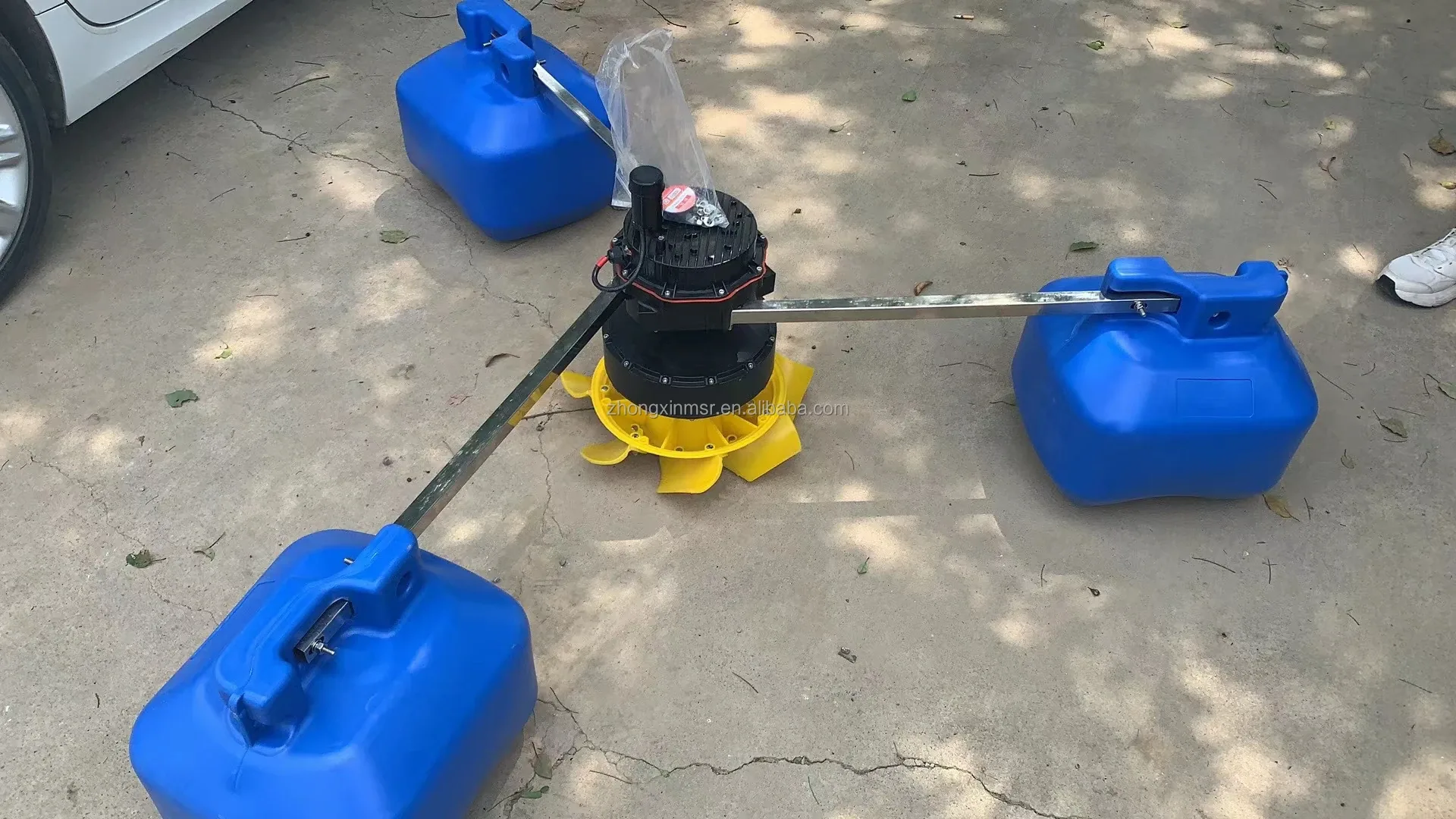
- Indonesian-style short-arm units carry 2-4 paddles on a short rotor and run at higher speed. They are cheaper per unit, easy to move between ponds, and popular for medium-density vannamei ponds across Sumatra and Java.
- Thai-style long-arm units carry 7-35 paddles on a long rotor and move much more water per revolution. They suit high-density ponds and larger water bodies, and are the default for intensive farms in Thailand and Vietnam.
Buying tip for Indonesian farms: match the machine family to your density. A short-arm unit is usually enough at 30-80 PL/m²; switch to long-arm or add units when you push toward 100-150 PL/m².
Importer and dealer notes (Indonesia)
If you are importing paddle wheel aerators into Indonesia, the buying process is mostly about paperwork and power:
- HS code: paddle wheel aerators for aquaculture typically fall under agricultural/fishery machinery headings (such as 8436.80 — other agricultural machinery) or electric-motor-based equipment; confirm classification with your broker, as it decides import duty.
- Voltage and frequency: Indonesian farms run 220 V / 50 Hz single-phase for small units and 380 V / 50 Hz three-phase for larger ones. Order the right motor — a 60 Hz or 440 V unit cannot simply be plugged in.
- Documentation: expect to provide commercial invoice, packing list, bill of lading and, for some ports, a surveyor certificate. Ask the factory for the certificate of origin if your trade agreement gives a duty preference.
- Sample policy: for first orders, factories usually offer 1-2 sample units before a container; confirm lead time (typically 2-4 weeks production) and spare parts (paddles, oil seals, bearings) included with the container.
FAQ
Q: What are the first symptoms that aeration is undersized?
A: Oxygen below 3 mg/L in the early morning, shrimp gathering at the pond edges or surface, slow feed intake, and dark, foul-smelling sediment in the center. Each symptom points to more aeration power or better placement, not just longer run time.
Q: How much electricity will paddle wheel aeration use?
A: A 1.5 kW unit running 20 hours a day uses about 30 kWh daily; a 3 kW unit about 60 kWh daily. At typical Indonesian industrial tariffs this is normally the largest single electricity cost on a shrimp farm — see our energy-saving guide for tropical shrimp farms for ways to cut it.
Q: Can I run fewer units longer instead of more units shorter?
A: Only within reason. Power sets the oxygen-transfer ceiling: two 1.5 kW units move more water and spread oxygen better than one 3 kW unit in a large pond, because coverage matters as much as total power. Place units so their circulation zones overlap slightly toward the pond center.
Q: Do I still need bottom aeration if I use paddle wheels?
A: In ponds deeper than about 1.8 m, or at high density, yes — paddle wheels oxygenate the surface layer while microporous bottom aeration keeps the bottom layer oxygenated, especially at night. Many intensive farms combine both.
Sizing help
Send us your pond area in hectares, target density and voltage, and we will recommend the number and power of paddle wheel aerators — or quote the complete set from our floating aerator range.
If you are comparing machine types, our pond aerator range covers the floating and paddle-wheel models side by side.