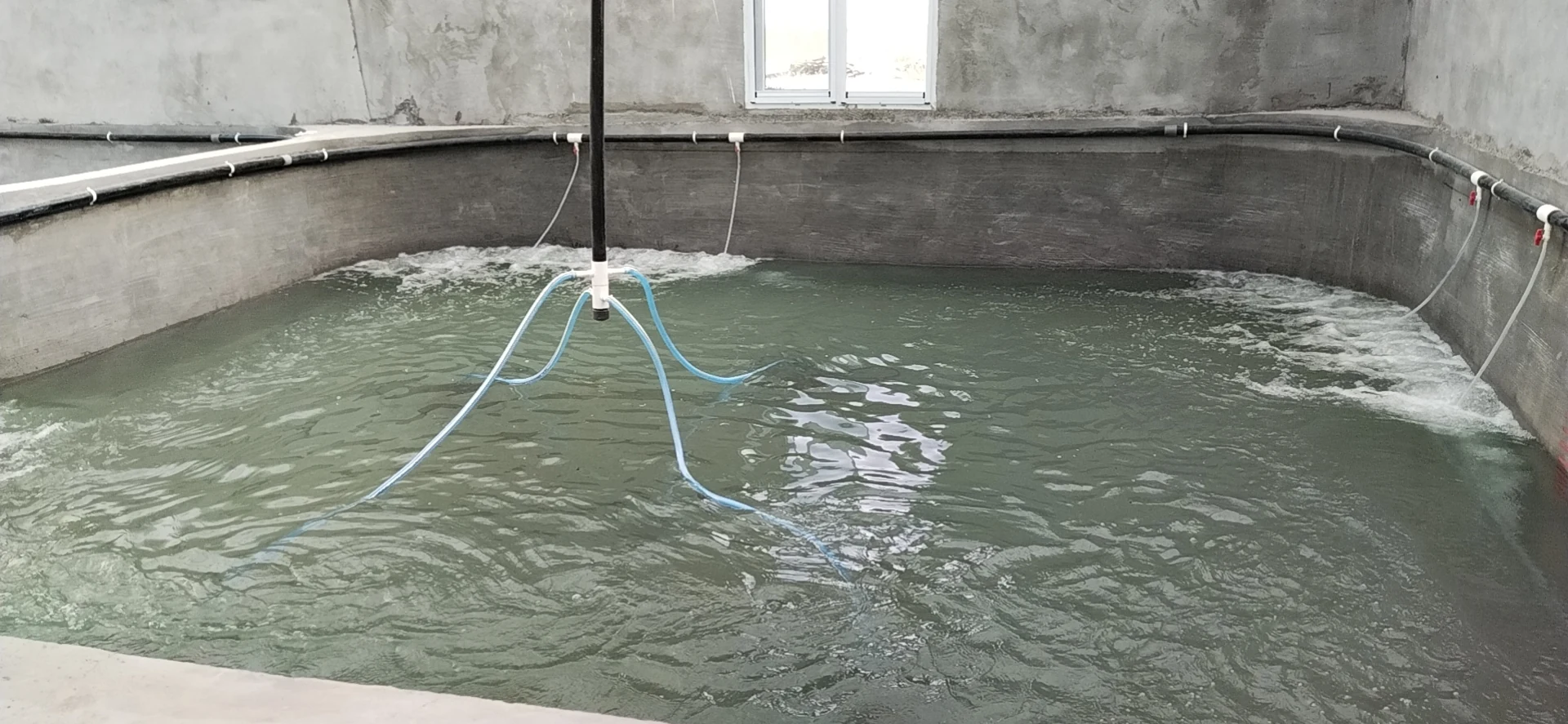
Ask five farms how they aerate and you will hear two answers: a floating aerator sitting on the surface throwing water into the air, or bottom (diffused) aeration — a blower feeding fine bubbles up from microporous tubing or discs on the pond floor. Both put oxygen into water. They do it at different depths, with different power bills and different costs, and choosing wrong means either a dead zone at the bottom of your pond or money spent on capacity you never use.
This guide compares the two systems on the decisions that matter: depth, oxygen delivery, electricity, cost and maintenance — then shows the combination layout most professional farms end up with.
How each system works
A floating aerator is a self-contained machine that floats on the pond surface. An impeller lifts water and throws it into the air, where droplets absorb oxygen before falling back; the same motion drives circulation that keeps the surface layer mixed. It works at any water depth, follows the water level automatically, and needs no blower house or pipe network. VFD (variable-frequency) models vary speed with oxygen demand instead of running flat-out.
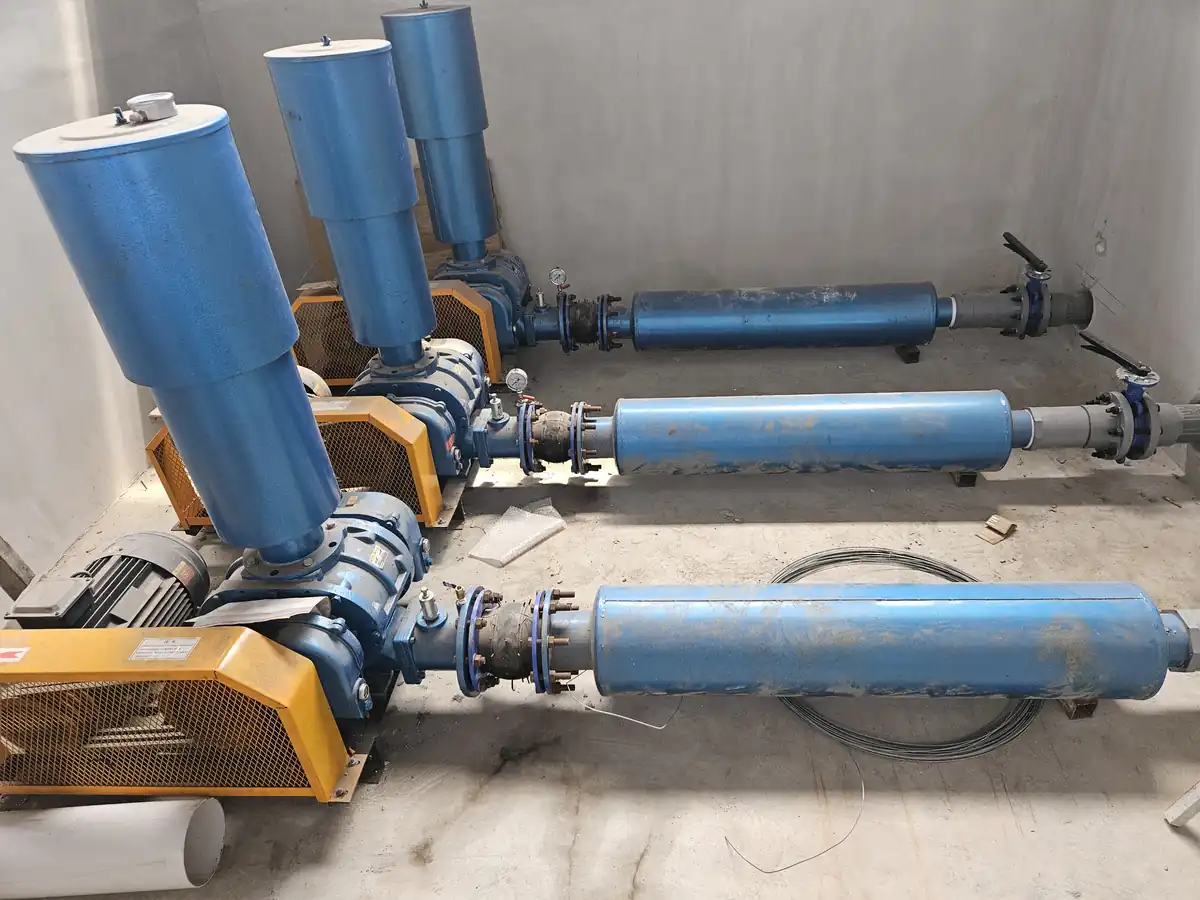
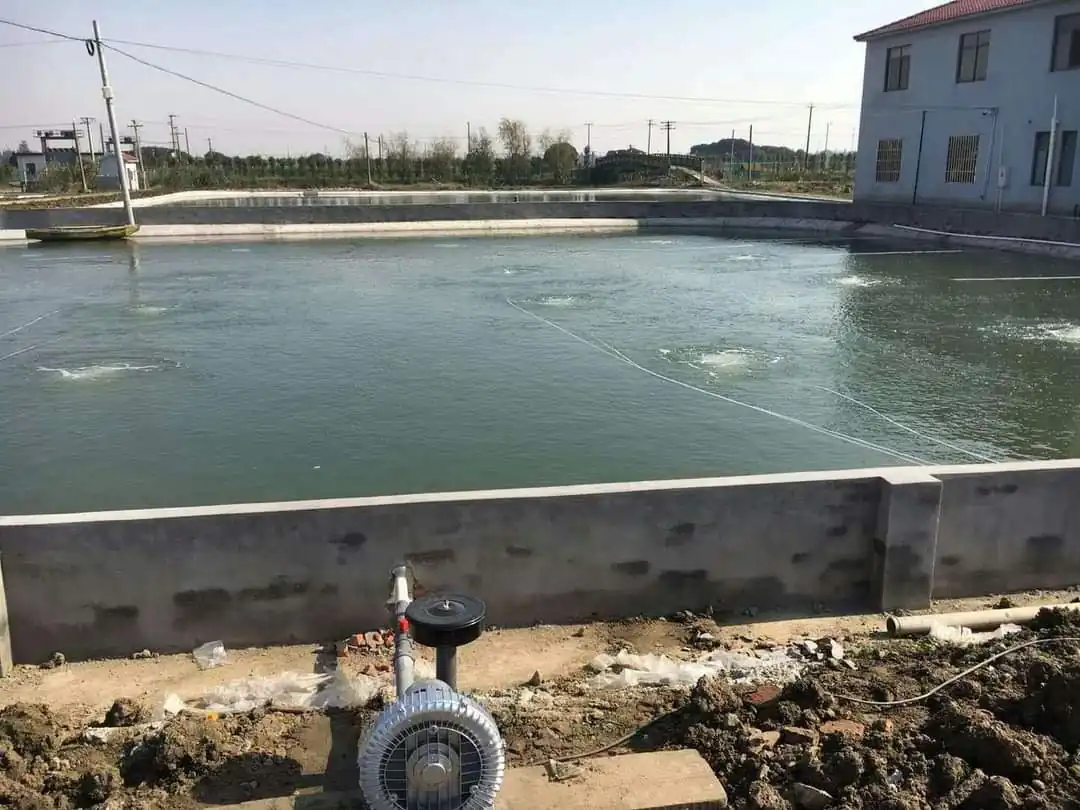
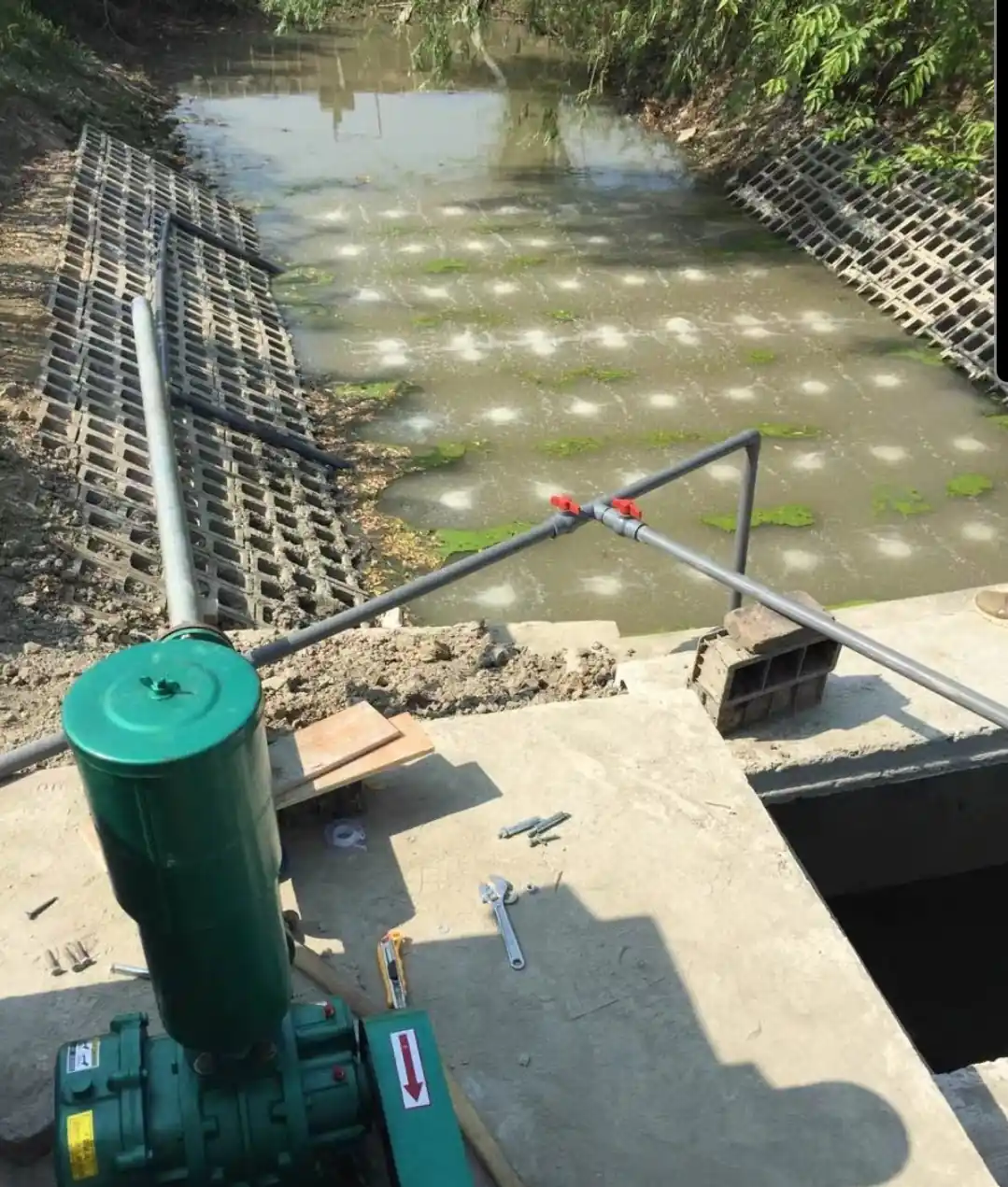
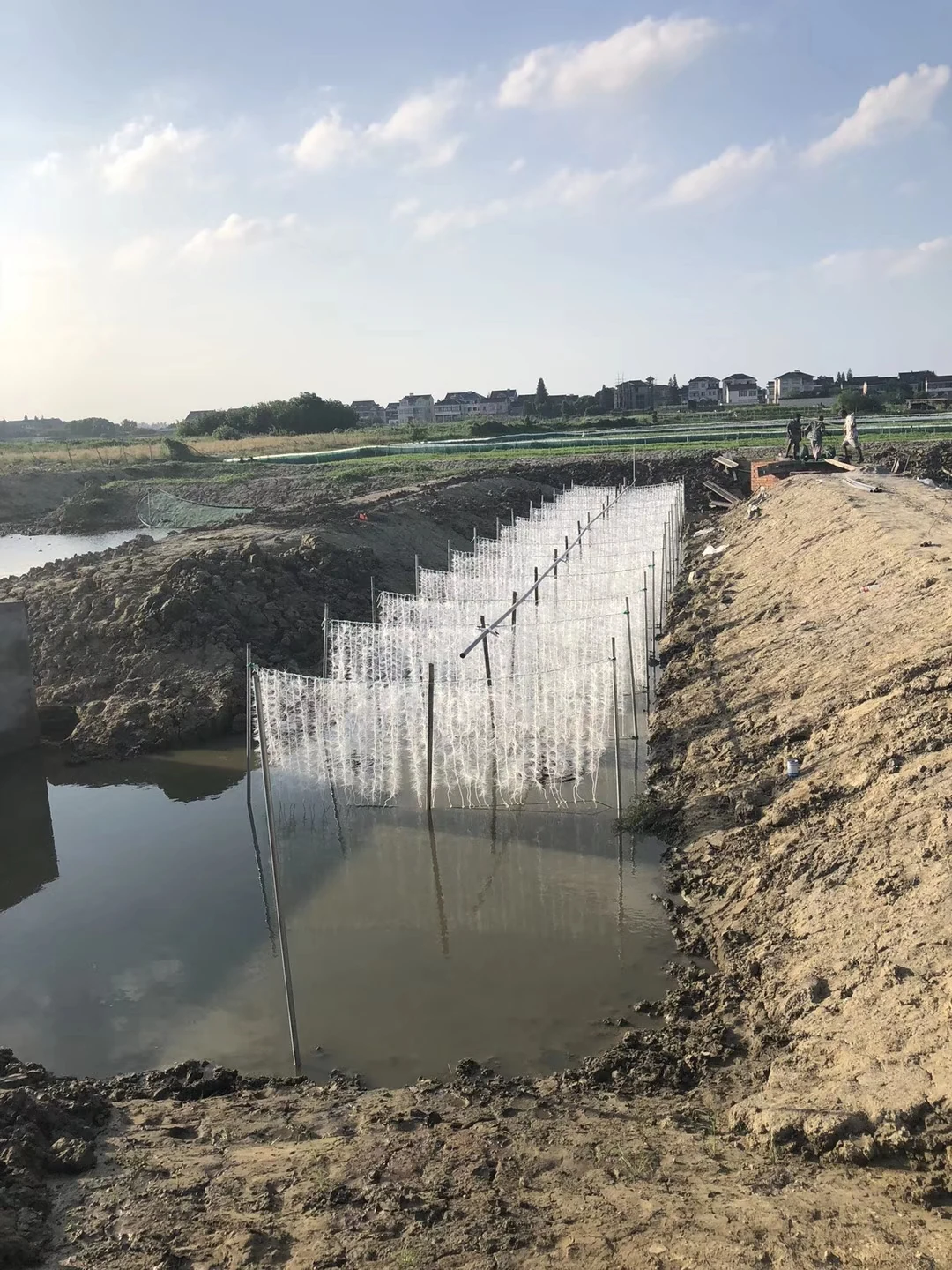
Bottom aeration is a complete system: a roots blower on the bank, a main pipe to a manifold, branch lines, and microporous tubing or discs laid 10-20 cm above the pond bottom. Fine bubbles rise through the whole water column, dissolving along the way and dragging deeper water up to the surface — oxygen is delivered where the shrimp and fish actually live, and the sediment layer is kept aerobic.
Where each system delivers oxygen
This is the single most important difference.
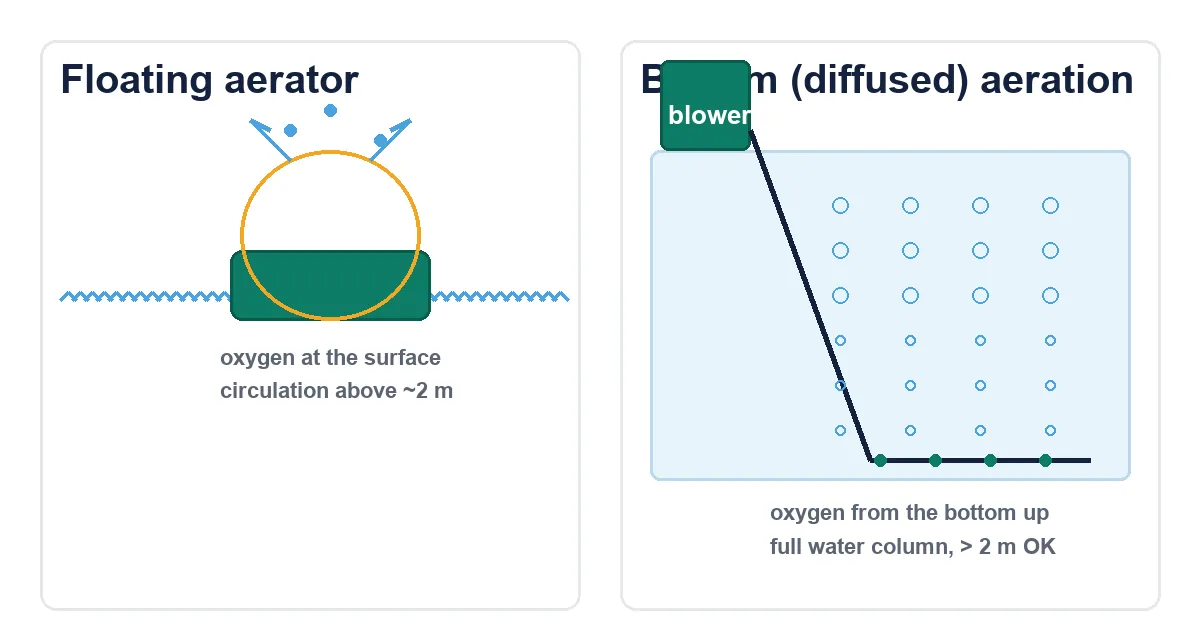
A floating aerator oxygenates the surface layer and circulates the upper water. It is excellent at mixing and at fast emergency re-oxygenation — minutes, not hours. But it does not directly drive oxygen into the bottom of a deep pond; below about 2 m, its effect fades quickly.
Bottom aeration delivers oxygen from the bottom up. The rising fine bubbles oxygenate the deepest water first — the layer where shrimp sit at night and where organic matter decomposes — and the bubble plume acts as an airlift, continuously exchanging bottom water with surface water. For ponds deeper than 1.5-2 m, bottom aeration is the only system that reliably prevents chronic bottom hypoxia.
Electricity: the real operating cost
Electricity is the largest running cost of aeration, so efficiency decides the long-term winner:
- Fine-bubble bottom aeration is the most efficient way to put oxygen into water. Field practice across our installations shows fine-bubble systems save roughly 50% of the electricity of an equivalent paddle-wheel setup, because small bubbles have a high surface-to-volume ratio and dissolve far more completely than splash aeration.
- VFD floating aerators save 20-30% of the electricity of a fixed-speed aerator, by matching speed to demand: full speed after feeding and in hot weather, reduced speed at night and in cool seasons. The permanent-magnet motor also runs cooler, quieter and lighter than an induction motor of the same power.
Sizing benchmarks to plan your budget: a VFD floating aerator of 1.5-3.0 kW covers roughly 4-12 mu (0.3-0.8 ha) depending on model and stocking density; bottom aeration follows the rule of 1 kW of blower per 100-150 m of microporous tubing, with air demand of 0.1-0.4 m³/h per metre of tubing and blower pressure = water depth + 15-20% headroom (a 3 m pond needs about 0.35-0.45 bar). A full step-by-step calculation is in our aeration equipment types guide, and the deep-dive on fine-bubble versus paddle-wheel economics is in our tropical pond comparison.
Cost and maintenance
Floating aerator — lower first cost per unit, no pipe network, install by anchoring in place. Maintenance is the motor and impeller: keep the cable slack clear of the blades, protect the plug from rain, and in winter lift the machine out, drain it and store it dry. Spares (impellers, shaft seals, controllers) are cheap and quick to replace. Power: 220 V single-phase or 380 V three-phase, always with a residual current device (RCD). See the full floating aerator range.
Bottom aeration — higher first cost: blower + main/branch pipes + manifold + tubing or discs, plus installation labour. Running maintenance is the blower: check oil monthly, change it per the manual, keep the intake filter clean. A maintained ZXMSR roots blower runs reliably for many seasons, and parts are inexpensive and fully interchangeable across the series.
The decision matrix
| Decision factor | Floating aerator | Bottom aeration |
|---|---|---|
| Pond depth | Any; best < 2 m | Best > 1.5-2 m |
| Where oxygen is delivered | Surface + circulation | Bottom up, full column |
| Emergency re-oxygenation | Minutes — excellent | Slower (blower ramp-up) |
| Electricity efficiency | 20-30% saving vs fixed paddle | ~50% saving vs paddle wheel |
| First cost | Low per unit, scale as needed | High (blower + pipe network) |
| Maintenance | Motor + impeller | Blower oil/filter + pipe checks |
| Layout flexibility | Move unit where needed | Fixed layout, valves per branch |
| Deep-pond bottom layer | Not directly oxygenated | Directly oxygenated |
When to combine both
Most high-density, deep-water farms — vannamei ponds of 2-3 m, catfish ponds, RAS-adjacent systems — do not pick one. They run bottom aeration as the primary oxygen system and keep 1-2 floating aerators per pond as emergency and hot-weather boosters. The floating unit restores surface oxygen in minutes during a power cut or a sudden storm-driven oxygen crash, while the blower system does the steady work. Surface mixing and bottom oxygenation are complementary, not competing.
For shallow ponds (under 1.5 m) with low-to-moderate stocking, a VFD floating aerator alone is often the sensible, lowest-cost choice — it mixes the shallow column thoroughly and the efficiency penalty versus fine bubble is small at that depth.
Bottom line
Match the system to the depth first, then to your electricity price and stocking density:
- Ponds under ~1.5-2 m, moderate density → a VFD floating aerator is simple, flexible and cost-effective.
- Ponds over ~2 m, or shrimp/catfish at commercial density → bottom aeration with microporous tubing is the efficiency and survival winner.
- Deep ponds at high density → run bottom aeration as primary, add 1-2 floating aerators per pond for emergency and peak-load boost.
- Any pond with power-cut risk → keep at least one floating aerator, because minutes matter when oxygen crashes — see our power outage emergency guide.
For the complete from-blower-to-pond-bottom design (manifolds, valves, tubing layout), read our complete aeration system guide.
Send us your pond area, depth and species — our engineers reply within 24 hours with a complete layout: blower model, tubing length, aerator count and the wiring schematic, so every part of your aeration system comes from one source with one service contact.
Q: Which is better for a deep pond (over 2 m)? A: Bottom aeration. A floating aerator mixes and oxygenates the surface layer, but below about 2 m its effect fades; fine bubbles from bottom tubing oxygenate the deepest water first, where shrimp and fish actually live.
Q: Is a floating aerator cheaper than bottom aeration? A: Per unit, yes — no blower house, no pipe network, lower first cost. But a floating aerator covers only 4-12 mu per unit, while bottom aeration spreads the blower cost over many lines and ponds. Compare total system cost per mu, not unit price.
Q: Can I use a floating aerator and bottom aeration together? A: Yes, and most commercial farms do: bottom aeration as the primary oxygen system, 1-2 floating aerators per pond for emergency re-oxygenation and hot-weather boost. The two deliver oxygen to different layers — surface mixing plus bottom oxygenation.
Q: Which system saves more electricity? A: Fine-bubble bottom aeration saves roughly 50% of the electricity of a paddle-wheel setup. A VFD floating aerator saves 20-30% versus a fixed-speed aerator. Bottom aeration is the efficiency champion; the VFD aerator is the best surface option.
Q: What about shallow ponds (under 1.5 m)? A: A VFD floating aerator is usually the best choice: it mixes the whole shallow column thoroughly, the efficiency gap versus fine bubble is small at that depth, and there is no pipe network to install or maintain.
Q: How much power does each system need? A: Floating aerator: 1.5-3.0 kW per 4-12 mu. Bottom aeration: 1 kW of blower per 100-150 m of microporous tubing, with blower pressure equal to water depth plus 15-20% headroom — a 3 m pond needs roughly 0.35-0.45 bar.
Q: Which is better for power outages? A: A floating aerator: it restores surface oxygen in minutes, so keep at least one per pond where power cuts are a risk (pair it with a generator). Bottom aeration depends on the blower, which needs backup power to restart.
The floating unit in this comparison is on the VFD floating aerator page.