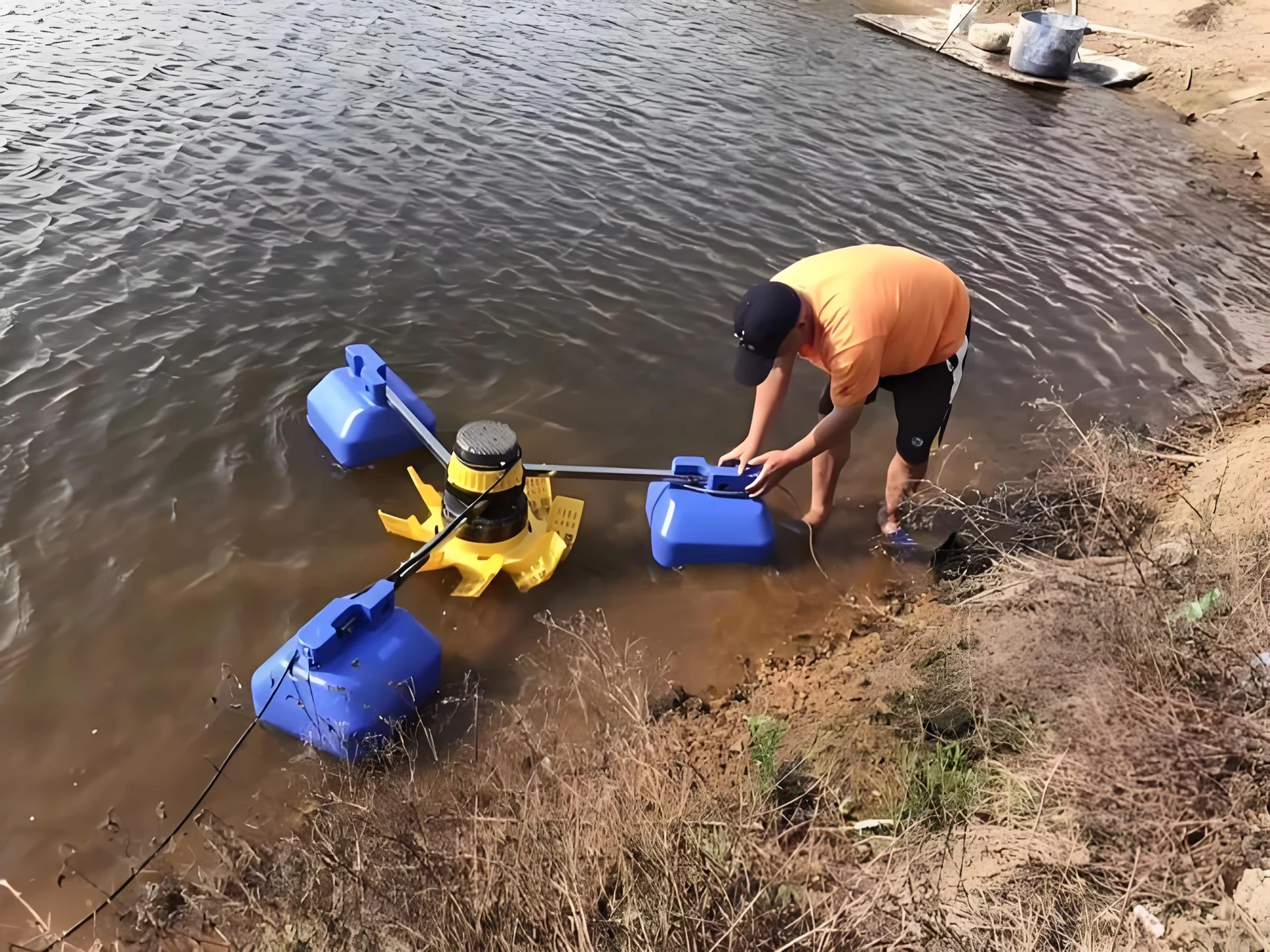
Ask farmers in Indonesia, Vietnam, the Philippines or Brazil which season they fear most and most will say the monsoon. Not because the rain itself kills fish — but because the weather that comes with it sets off a chain of events that ends in dissolved oxygen (DO) collapse: the pre-storm heat and low pressure, the sudden cooling that flips the water column, the die-off of algae, and the power cuts that take the aerators offline exactly when they are needed most.
Aeration is the main weapon in this fight. This guide gives a practical monsoon DO plan — what to do before the rain, during the storm, and in the recovery days after — built around real oxygen targets and backup thinking.
Why DO crashes in the rainy season
Four mechanisms, often in sequence:
1. Pre-storm heat and low pressure. Before a storm, skies cloud over and air pressure drops, while the heat stays. Warm, still water holds less oxygen, algae slow their photosynthesis, and fish metabolism is still high — the classic recipe for a slow oxygen decline before a single drop of rain falls.
2. Sudden cooling and stratification flip. Heavy rain cools the surface layer sharply. Cold water is denser, so it sinks, dragging surface water — and whatever oxygen problems it has — to the bottom, and stirring up sediment and organic matter that consume oxygen as they decompose.
3. Algae die-off. After several overcast days, light-starved algae die in mass. Decomposing algae consume large amounts of oxygen and can release ammonia. The pond that "looks green" before the storm can be oxygen-poor and dirty within days after it.
4. Power cuts. Monsoon storms knock out power lines. In a pond with no backup, aerators stop at the exact moment the oxygen situation turns critical — and DO can fall below safe levels in hours.
Keep the operating targets in mind through all of this: 3-5 mg/L at the pond bottom for fish, 4-6 mg/L for shrimp; below 2 mg/L stress and mortality begin, especially around dawn. In monsoon weather, assume the worst and manage to the upper end — shrimp farmers can follow the full routine in our dissolved oxygen management guide for shrimp farming.
Before the rain: the 48-hour checklist
A storm forecast is an oxygen-management trigger, not a warning to wait:
- Run aeration earlier and longer than usual. Pre-oxygenate before the sky darkens. A pond entering a storm with a full oxygen reserve absorbs the first shocks far better than one already near its minimum.
- Service the blower now. Check oil, clean the intake filter, confirm the belt and check valves are sound — a blower that fails mid-storm is a disaster you can prevent with a 20-minute check. Our ZXMSR roots blowers are designed for this continuous storm-season duty.
- Inspect and test backup power. If you rely on a generator, start it and run it under load for 15 minutes. If you have a battery or solar backup, verify charge and connections. The time to discover a dead battery is not during a blackout.
- Protect the electrical side. Check that plugs, cables and breakers are rain-protected and that residual current devices (RCDs) work. Wet-power failures take aerators offline and are a shock hazard.
- Secure inlet and outlet structures. Prevent muddy inflow from overwhelming the pond during heavy rain — the full checklist is in our cold-rain loss-prevention guide.
During the rain: keep mixing, keep feeding oxygen
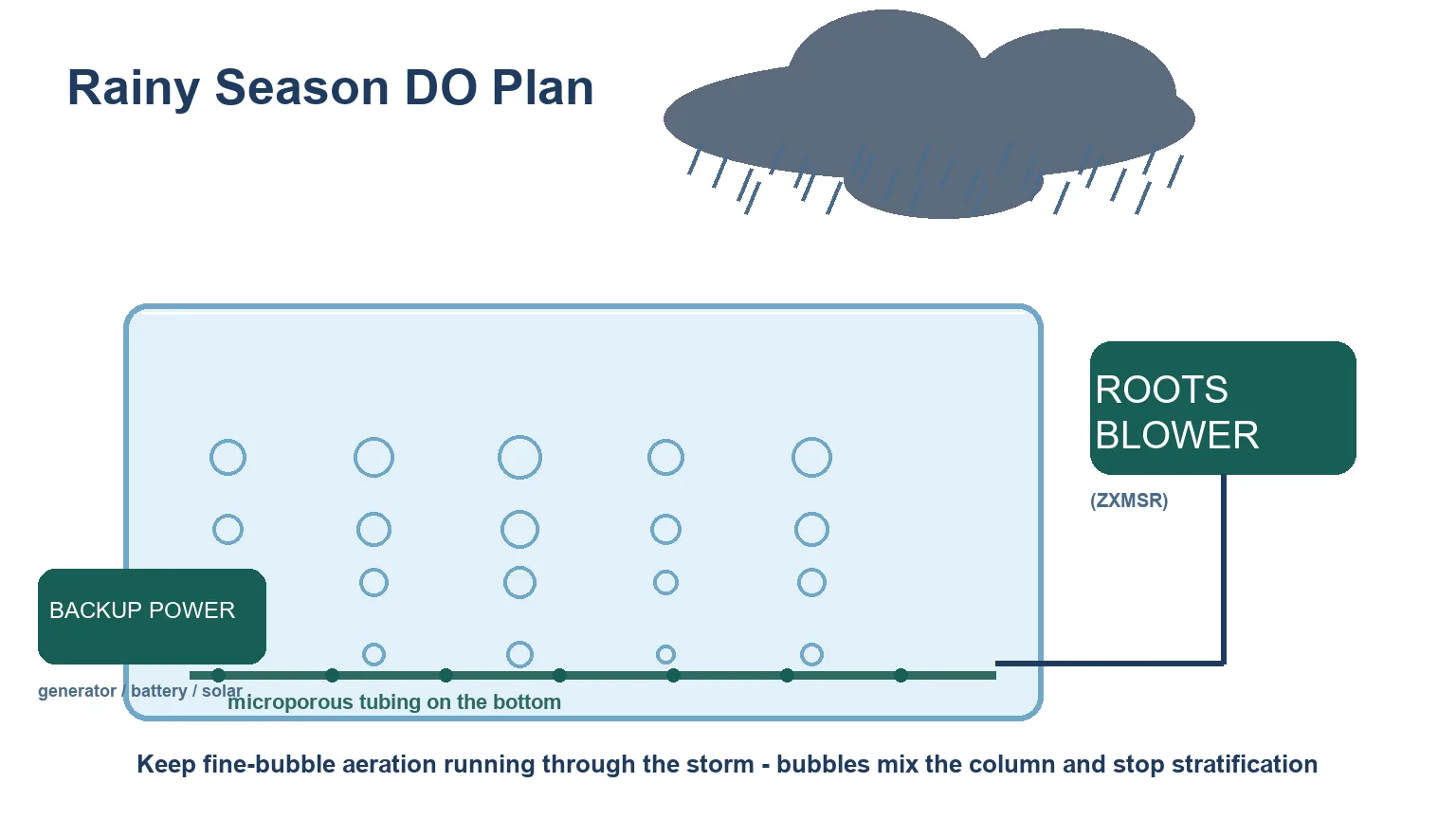
- Do not stop bottom aeration. Fine-bubble microporous aeration keeps oxygen moving through the column and prevents stratification from setting in. This is the most important single action during a storm.
- Use the bubbles as mixers. The rising bubbles act as an airlift, exchanging bottom and surface water, which counters the density-driven flip from cold rain and keeps the water column from separating into an oxygen-rich top and an oxygen-poor bottom.
- Control inflow. If runoff is muddy, cut the water source or let it settle before letting it in — mud and debris consume oxygen and cloud the water.
- If the power goes out, start your backup immediately and follow the emergency sequence in our power outage emergency guide: know which ponds get the generator first — usually the densest stocking and the most valuable crop.
After the rain: the recovery window
The days after a storm are as dangerous as the storm itself:
- Watch DO around the clock for 24-48 hours. Algal die-off continues after the rain stops, so DO can keep dropping into the night. Monitor at dawn — the daily minimum — for at least two mornings.
- Keep aerators running through the recovery. It is tempting to switch off when the sun returns; resist until DO readings hold above target for a full day.
- Change water carefully. On a stable sunny day, drain and replace water gradually, and mind the temperature difference between new water and the pond — large swings stress fish further.
- Support nitrification. Rain and decomposing algae push ammonia and nitrite up. Aeration keeps the nitrifying bacteria working; keep DO up while the nitrogen cycle rebalances.
Power cuts: the monsoon's real killer
Across Southeast Asia and Brazil, the pattern repeats every season: the storm that drops the oxygen also cuts the power. The defense is layered and planned before the season:
1. Generator sized for your blower load — the most reliable layer where outages are common and long.
2. Battery or solar hybrid for short gaps — enough to carry fine-bubble aeration through a 1-2 hour outage, and it trims the daytime electricity bill the rest of the year.
3. Spare blower or blower heads on site — storm season is when single points of failure reveal themselves.
4. Prioritise your ponds — write down the order in which ponds get backup power during a multi-hour outage, from highest stocking density down.
Seasonal configuration tips
- Re-check tubing and manifolds before the season. Rainy-season floods can shift bottom tubing; walk the banks and confirm layouts after any major inflow, and follow the checks in our microporous aeration tube maintenance guide.
- Raise and protect blower shelters. A blower house that floods or rains inside stops aeration at the worst time. Ventilation, rain protection and an elevated floor matter.
- Plan for the "rainy-season electricity bill". Longer run times and lower DO tolerance mean higher consumption; fine-bubble microporous systems cut that bill by roughly half compared with paddle wheels — a big seasonal advantage.
Bottom line
The monsoon kills ponds through oxygen, not water. Treat every storm forecast as an aeration trigger: pre-oxygenate 48 hours out, keep fine-bubble aeration running through the rain to stop stratification, test backup power before the season, and monitor DO for two full mornings after the storm. Farmers who run this DO plan through the rainy season lose fewer fish — and sleep better through the storms.
Send us your pond area, depth and species — our engineers reply within 24 hours with a blower and backup recommendation sized for your site and your power situation.
FAQ
Q: Why do fish die in the rainy season? A: The chain is: pre-storm heat and low pressure lower DO, sudden cooling flips and mixes the water column, algae die off and decompose (consuming oxygen), and power cuts stop the aerators at the worst moment. Rarely is the rain itself the direct killer.
Q: Should I run aeration during rain? A: Yes. Keep bottom aeration running — it maintains oxygen through the column and the rising bubbles act as mixers that prevent the cold-rain stratification flip. Control muddy inflow separately.
Q: What is the biggest risk during a monsoon storm? A: The power cut. DO can fall below safe levels within hours of the aerators stopping, while the storm itself is already pushing oxygen down. Backup power is the single most valuable monsoon investment.
Q: How should I prepare my aeration system before the rainy season? A: Service the blower (oil, filter, belt, check valves), test backup power under load, protect all electrical connections from rain, check inlet and outlet structures, and confirm tubing and manifolds are in place after any flood.
Q: Do I need to aerate more after heavy rain? A: For 24-48 hours, yes. Algal die-off continues after the rain stops, so DO can keep falling — monitor at dawn for two mornings and keep aerators running until DO holds above target for a full day.
Q: Can solar or battery backup cover a monsoon outage? A: Yes, for short gaps. Size the battery or solar system for your blower load to carry fine-bubble aeration through a 1-2 hour outage; for long outages use a generator. Many farms combine both.