Every aquaculture farm that grows past the backyard stage faces the same question: which air blower should stand next to the pond? For bottom aeration with microporous tubing and discs, the realistic shortlist is two machines — a roots (positive-displacement) blower and a turbo (high-speed centrifugal) blower. They deliver the same thing — air — but their economics are completely different.
This guide compares them on the four numbers that decide farm profitability: efficiency, purchase cost, maintenance, and payback. At the end you will know exactly when a turbo blower pays for itself — and when it is wasted money.
Full disclosure first: we manufacture roots blowers (ZXMSR series) and complete microporous aeration systems. We do not make turbo blowers. We wrote this comparison so you can choose honestly — and if a turbo is genuinely the right answer for your farm, we will tell you so and point you to what to look for.
How each blower works
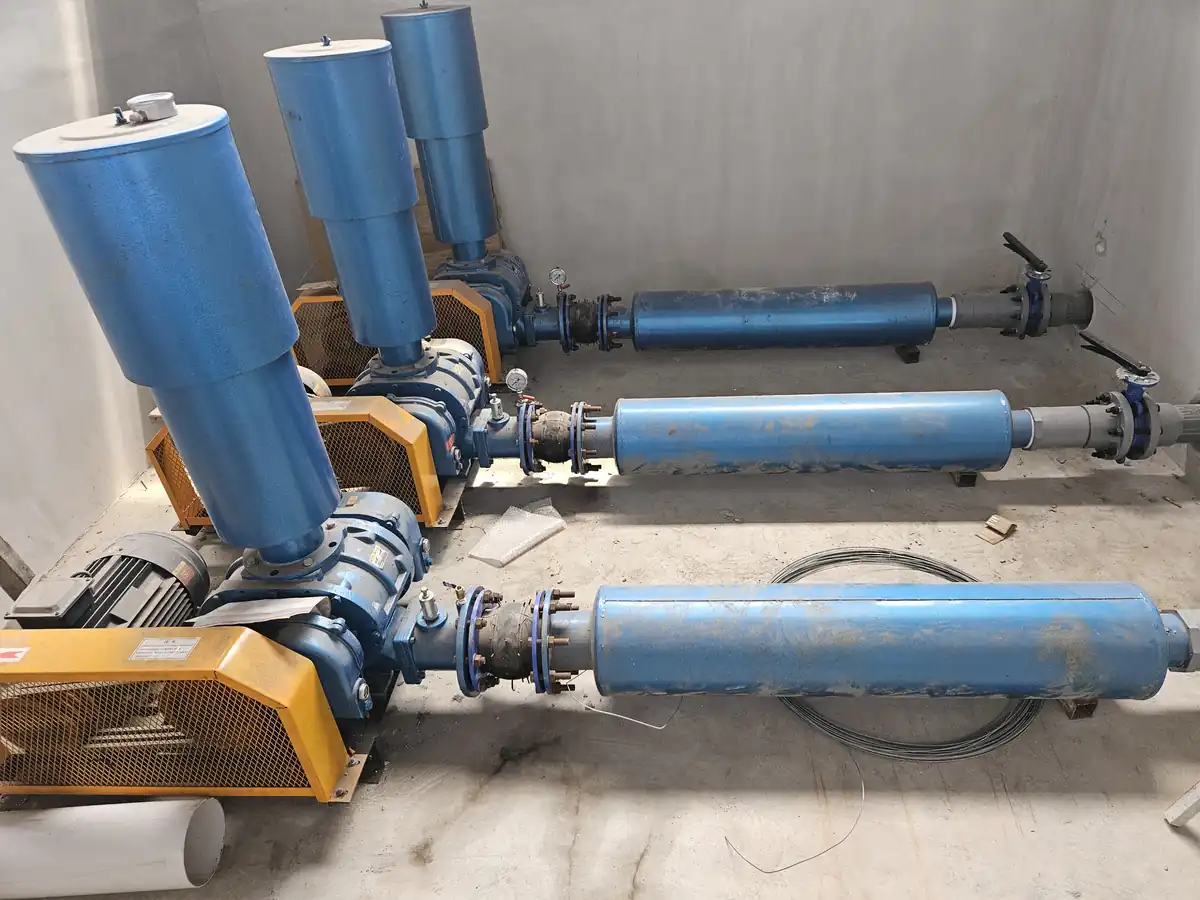
Roots blowers are positive-displacement machines. Two lobed rotors trap a fixed volume of air and push it out against the system pressure. Flow is essentially constant — whether the line is 100 m or 200 m of tubing, the blower keeps delivering its rated volume while pressure rises to match the backpressure.
Turbo blowers are centrifugal machines with a high-speed motor (typically 20,000-50,000 rpm) and magnetic bearings. Air is accelerated radially and converted to pressure. The motor speed is electronically controlled, so the blower can match air delivery to real-time demand — the key advantage that changes the whole cost picture.
Efficiency: the load-curve story
This is the number that usually sells a turbo. At full load, a large roots blower and a turbo blower are not far apart — both convert roughly 55-70% of motor input into useful air work at their best point. The gap appears below full load:
- A roots blower is a constant-volume machine. If the pond needs only 60% of the blower's rated flow, you throttle or bypass — but the motor still draws near-rated power. Partial-load efficiency drops steeply.
- A turbo blower varies speed with demand. At 60% flow it may draw only 40-50% of full-load power — a real saving on any farm that runs several ponds at different stocking densities.
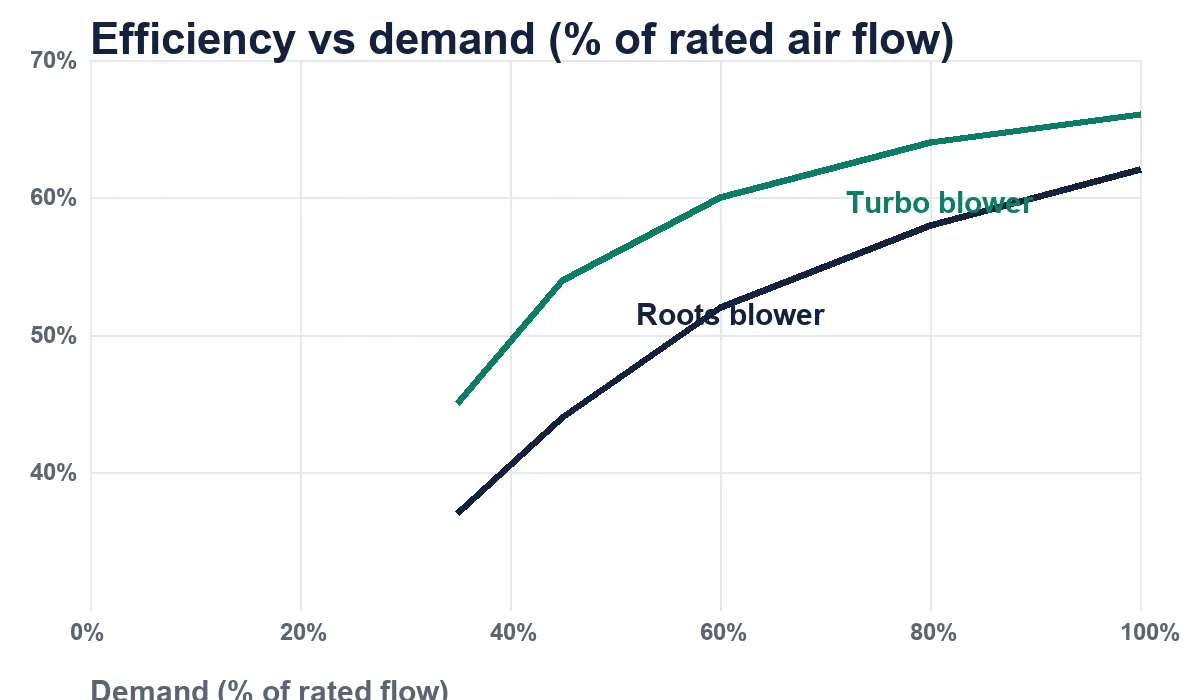
Rule of thumb: if your blower runs most of its life at or near full capacity (single large pond, steady demand), the efficiency gap is small. If your demand swings widely (multiple ponds, batch stocking, season changes), the turbo's variable speed earns its keep.
What each machine costs to own
Purchase cost. A turbo blower typically costs 2.5-4x a roots blower of similar peak output. For a 30 kW duty that is often the difference between a US$4,000-6,000 roots package and a US$12,000-20,000 turbo unit — before installation.
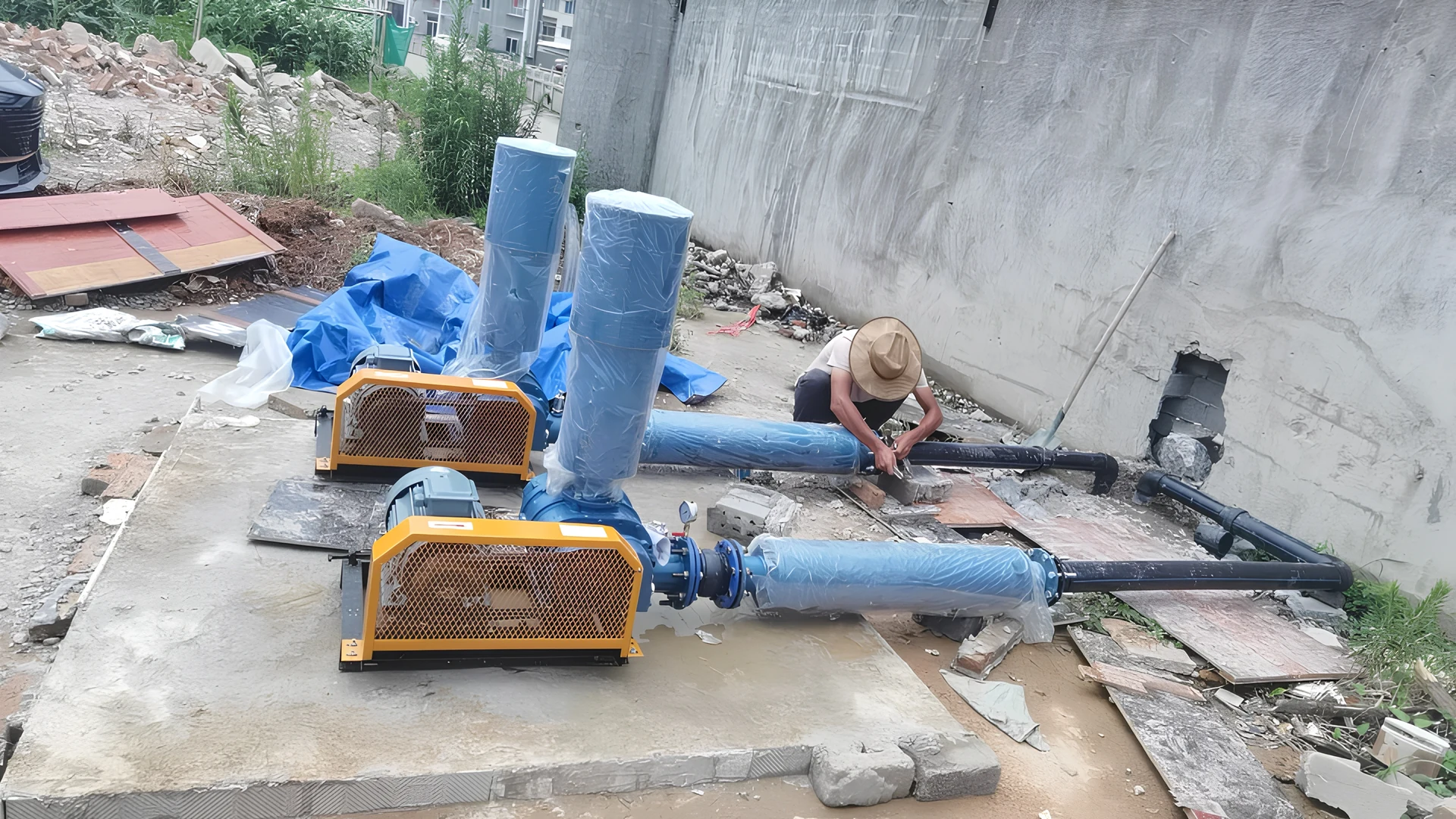
Maintenance. A roots blower is a simple machine: two rotors, timing gears, bearings. Routine care is checking oil monthly, changing it per the manual, and keeping the intake filter clean. A maintained ZXMSR unit runs reliably for many seasons, and parts are inexpensive and interchangeable across the ZXMSR series.
A turbo's magnetic-bearing, high-speed motor needs almost no routine maintenance — but when it does fail, repair usually means returning the motor unit to the manufacturer, with downtime and cost far beyond a roots blower rebuild. Spare parts are not shelf items in most farming regions.
Noise. Modern roots blowers with spiral intake structures and silencers run at 60-75 dB(A) at 1 m — acceptable for farm duty. Turbos are quieter (55-65 dB(A)) and vibration-free, which matters for RAS facilities inside buildings.
When the turbo pays for itself
A turbo only earns its premium through energy savings, so the math is simple: savings per year must exceed the extra purchase cost within an acceptable payback.
Worked example — a farm with fluctuating demand averaging 70% of a 30 kW rated load:
| Item | Roots blower | Turbo blower |
|---|---|---|
| Rated power | 30 kW | 30 kW |
| Actual average draw (70% demand) | ~28 kW (throttled, near-rated) | ~19 kW (speed-controlled) |
| Energy per year (8,760 h) | 245,280 kWh | 166,440 kWh |
| Annual energy cost @ US$0.12/kWh | US$29,434 | US$19,973 |
| Annual saving | — | US$9,461 |
| Extra purchase cost | — | US$8,000-14,000 |
| Payback | — | ~1-1.5 years |
Now the same 30 kW unit running flat-out all year (single pond, constant demand):
| Item | Roots blower | Turbo blower |
|---|---|---|
| Actual average draw | ~30 kW | ~27 kW (best point) |
| Annual energy cost | US$31,536 | US$28,386 |
| Annual saving | — | US$3,150 |
| Extra purchase cost | — | US$8,000-14,000 |
| Payback | — | ~3-4.5 years |
The conclusion is uncomfortable but true: on fluctuating multi-pond farms with high electricity prices (typical for Southeast Asia, the Middle East and Brazil), a turbo can pay back in 1-2 years and is a genuine investment. On constant-load single-pond farms, the payback stretches past 3 years — most farms will never see the benefit before the next equipment cycle.
When a roots blower is the right call
For the majority of aquaculture operations — ponds up to 20-30 mu (1.3-2 ha), depths under 3 m, and blowers under 30-40 kW — a quality roots blower is the economically correct choice:
- Sizing rule of thumb: 1 kW of motor supports roughly 100-150 m of microporous tubing; air demand is tubing length x 0.1-0.4 m³/h per metre; pressure is water depth plus 15-20% headroom (a 3 m pond needs about 0.35-0.45 bar). A full step-by-step method is in our roots blower sizing guide.
- ZXMSR series covers the whole range with 11 models, 0.4 to 136+ m³/min and up to 98 kPa — from a 1-mu nursery to 50+ mu farms, so you size exactly to demand instead of overspending.
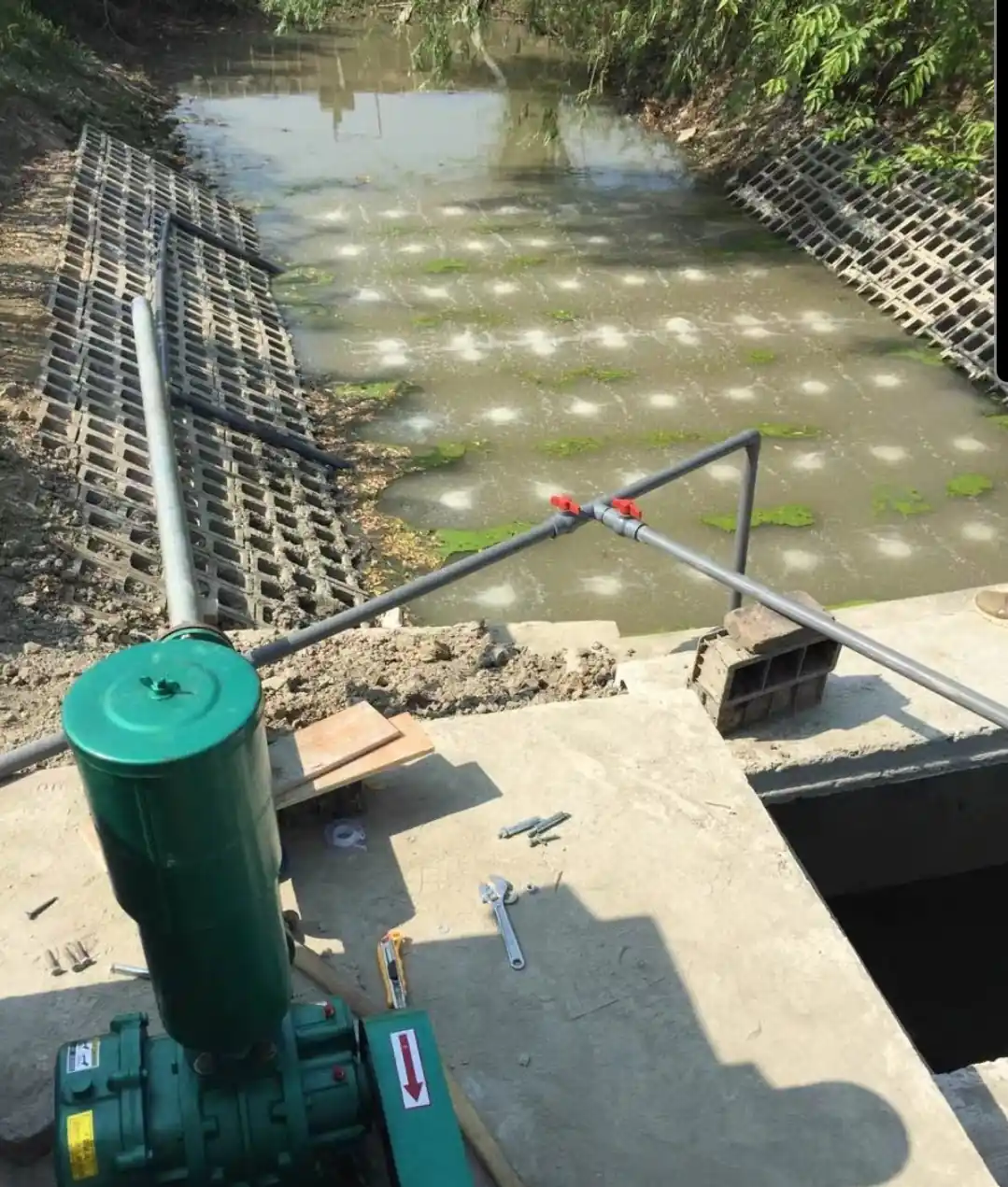
- Positive displacement holds pressure when lines partially block and feeds several ponds from one manifold with isolation valves — a practical advantage turboless small farms rely on daily. See the installation guide for manifold design.
- Total cost of ownership is predictable and low, spare parts are cheap, and local maintenance staff can service a roots blower. For the wider system picture, read our complete equipment guide.
Decision matrix
| Decision factor | Choose roots blower | Choose turbo blower |
|---|---|---|
| Farm size / blower duty | < 30-40 kW | > 50 kW, long runtime |
| Demand profile | Single pond, steady | Multiple ponds, variable |
| Pond depth | < 3 m | > 3 m, high pressure |
| Electricity price | Low-mid (US$0.05-0.10/kWh) | High (US$0.12+/kWh) |
| Budget / first cost | Sensitive | Can absorb premium |
| Maintenance capability | Limited local service | Factory/motor service access |
| Payback tolerance | < 2 years | 1-2 years acceptable |
Bottom line
Buy the cheapest machine that does the job — that is usually a roots blower. Buy the expensive one only when the energy math proves itself, which means variable demand, high electricity price, and a duty above 50 kW. If you are not sure, calculate your tubing length, depth and expected run hours first; the payback table above will answer the question faster than any salesman. For farms already fighting high power bills, our energy-saving guide for tropical shrimp farming covers the demand-side levers that work before you upgrade machinery.
Whatever you choose, size the system properly — under-aerated ponds lose stock, and over-aerated ponds waste the very money this comparison is about. Our engineers reply within 24 hours with a free system layout for your pond area, depth and stocking density.
Q: Is a turbo blower more energy-efficient than a roots blower? A: At full load, the difference is small (both roughly 55-70% at best point). The turbo's real advantage is partial load: at 60% demand it can draw 40-50% of full-load power, while a throttled roots blower stays near rated draw. Savings depend on how variable your demand is.
Q: How long does a turbo blower take to pay back? A: On a fluctuating multi-pond farm at US$0.12/kWh, typically 1-2 years. On a constant-load single pond, 3-4.5 years — usually not worth it. Use the worked examples above with your own electricity price.
Q: Why is a turbo blower so much more expensive? A: High-speed permanent-magnet motors, magnetic bearings and electronic control systems cost far more than the two rotors and gears of a roots blower — typically 2.5-4x the purchase price at similar peak output.
Q: Which blower is quieter? A: Turbo blowers are quieter (55-65 dB(A)) and vibration-free, ideal for indoor RAS. Modern roots blowers with silencers run 60-75 dB(A) at 1 m — fine for open ponds.
Q: Can a roots blower feed multiple ponds at different depths? A: Yes. Positive displacement holds pressure when lines partially block, and with a correctly sized manifold and an isolation valve per pond, one blower serves several ponds. Size for total air flow and the deepest pond's pressure.
Q: What maintenance does a roots blower need? A: Check oil level monthly, change oil per the manual schedule, keep the intake filter clean. Parts are inexpensive and interchangeable across the ZXMSR series — most farms service it locally.
Q: Is turbo blower output oil-free? A: Both types can deliver oil-free air. ZXMSR roots blowers use a special sealing design that keeps oil out of the casing, so output air is clean — essential for aquatic life. Check the same guarantee when specifying a turbo.
Our own unit in this comparison is on the intensive roots blower page.